Mamadou Sow, 1 April 2021
The G5 Sahel, or “G5S”, is an institutional framework for coordinating and monitoring regional cooperation on development and security policies. It was created at a summit held in February 2014 by five Sahel states: Mauritania, Mali, Burkina Faso, Niger and Chad. Spread over 5,097,338 km² with a population of more than 300 million and a trend towards growing urbanisation, the Sahel region offers enormous opportunities for its people. However, the region faces a resurgence of extremism, terrorism and crime, fuelled by endemic poverty, sharp income inequality, high youth unemployment and failures of governance [1] stemming from a lack of democracy, which have led to political, economic, social, cultural, ethnic and religious tensions, and even to civil or border wars in Africa, notably in the Sahel.
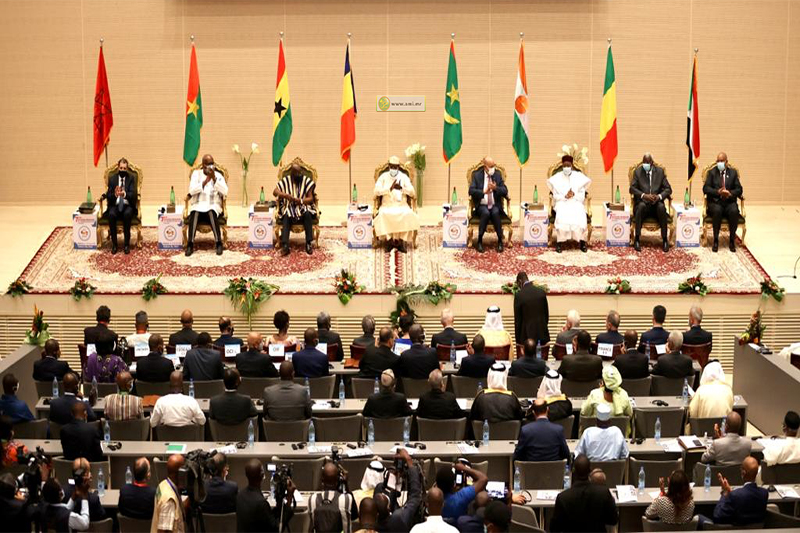
The five heads of state of the G5 Sahel member countries and their partners met in N’Djamena (Chad) on 16 February 2021 at the joint invitation of the outgoing chair of the G5 Sahel, Mohamed Ould Ghazouani, and his Chadian counterpart, Idriss Déby Itno, the incoming chair. On the agenda were a review of the situation in the region and an assessment of the commitments made collectively at the Pau Summit [2] on 13 January 2020.
Given the importance of the summit, a number of non-member countries and organisations [3] attended to help find a solution to a security crisis that has now lasted eight years.
The heads of state of the G5 member countries [4] thus discussed a range of economic, political, social and security aspects in search of solutions for the security of the area.
For the area to regain its security, several issues must be debated and resolved, as the participants pointed out.
In his address by videoconference, French President Emmanuel Macron insisted on three points:
– not easing the pressure on terrorist groups;
– maintaining control over the three-border area [5], in particular with the contribution of the Chadian battalion; and
– conducting concrete operations in the area over the coming days and weeks to regain control of the situation.
If Emmanuel Macron insists on military matters, it is presumably because he envisages a rapid end to this war by all means, including, and above all, military ones. Yet rather than considering the military solution alone, it may be wiser to opt for a political solution involving negotiations with the political and military leaders of the armed groups and with the communities, some of which see the presence of French soldiers in their countries as problematic.
Nonetheless, France wants, at all costs, to bring Europe into this war, and some European countries are already taking part militarily, financially, logistically and in other ways.
At the same time, some of the heads of state present, such as Macky Sall of Senegal and Idriss Déby Itno, renewed the call for the G5 to be placed under Chapter VII of the UN Charter, something the Americans appeared to reject outright. In their view, given the current state of the conflict, and as in similar crises, a regime of targeted sanctions, particularly economic ones, combined with a lesser military effort could suffice.
But military action cannot be the only solution [6], given how vulnerable a large part of the population of the Sahel countries is. This is what led Senegalese President Macky Sall to say at the summit that he would like “MINUSMA to be given a more robust mandate”. He added that “beyond the military response, it is fortunate that the G5 Sahel strategy includes development for the most vulnerable areas through the framework of integrated, rapid-impact priority actions. This approach was adopted at the Nouakchott summit in February 2020.” Finally, the Senegalese president released one billion CFA francs for the G5 Sahel Executive Secretariat, to underline his commitment to the importance of development for the stability of these countries.
The same idea was raised by the Chadian head of state in his address to the summit, when he called on the international community to step up its financial efforts and to work, as a matter of urgency, for the development of the Sahel in order to address “poverty, the breeding ground of terrorism”.
After contradictory statements, now accepting, now rejecting the idea of opening a dialogue with these armed groups, it may have become clear to these countries that recourse to dialogue with them is inevitable [7].
And perhaps the repeated loss of life, particularly on the French side, is leading France to reflect on dialogue, which has become inevitable for it and its allies – a dialogue that might begin with the gradual withdrawal [8] of its forces, replacing them progressively with other foreign forces.
Moreover, the prevailing international situation, such as the global crisis caused by the Covid-19 pandemic, has led to deep political [9] and economic crises in the region. In addition, the Sahel region is experiencing tensions arising from cultural differences that feed the pace of the war. The instability of oil markets and the crises in West Asia, not to mention the fear that armed groups may acquire increasingly sophisticated weapons, could pave the way for faster contacts with these groups, so as to find a basis for agreement with them and bring this crisis to an end.
In conclusion, it can be said that at this summit France succeeded, one way or another, in bringing a number of countries into the battle it began in 2013 and which had almost led it into an impasse, by involving the international community and international, regional and subregional organisations in the meeting [10]. Even financial organisations, from Africa to Europe and the United States of America, were asked to intervene militarily or financially to help resolve the problem.
Given the uncertainties, one may wonder about the future of this French intervention, which lacks national or international legitimacy [11].
In any event, the governments of these countries should take on board that without good governance, donors will not rush to contribute financially to their development. They should likewise accept that the international community is not prepared to send its soldiers without expecting good results. Finally, they should bear in mind that financial aid remains subject to a number of conditions. This was confirmed by the United States of America when it announced more than eighty billion dollars in aid, revealed by the State Department in a speech by the Under Secretary of State for Political Affairs, David Hale, at the ministerial meeting of the International Coalition for the Sahel [12].
Mamadou Sow
1 April 2021
References
[1] “Alliance de l’OIT avec le G5 Sahel” (ILO alliance with the G5 Sahel). google.com (external website, opens in a new tab). Accessed 17 March 2021.
[2] On Monday 13 January 2020, the President of the French Republic, Emmanuel Macron, brought together the heads of state of Mali, Burkina Faso, Niger, Mauritania and Chad for a summit at the Château de Pau devoted to the situation in the Sahel.
[3] Morocco, represented by the head of government, Saad Eddine El Othmani; Ghana, represented by its president and current chair of ECOWAS (Economic Community of West African States), Nana Akufo-Addo; Senegal, represented by its president, Macky Sall; Moussa Faki Mahamat, chairperson of the African Union Commission; and Emmanuel Macron, who remained in Paris because of the Covid-19 health crisis and held closed-door talks with his G5 Sahel counterparts by videoconference.
[4] Mali, Mauritania, Niger, Burkina Faso and Chad.
[5] The borders of Mali, Niger and Burkina Faso.
[6] If the military solution alone could solve the problem, it would already have done so, given the presence of multinational forces under various names: Barkhane, MINUSMA, the African force, and Takuba (“sabre” in Tamasheq), made up of 13 countries – Germany, Belgium, Denmark, Estonia, France, Mali, Niger, Norway, the Netherlands, Portugal, the United Kingdom, Sweden and the Czech Republic – which is trying to put an end to the activities of the Islamist groups operating in the region. But Germany declined to respond: on 30 December 2019, Berlin formalised its decision not to take part in the Takuba force. Spain and the United Kingdom also refused to send their forces to the Sahel, delaying the start of the mission.
[7] Mali faut il dialoguer avec les djihadistes (external website, opens in a new tab) · DW
Mali : le pouvoir annonce un dialogue avec des "groupes radicaux" (external website, opens in a new tab) · Anadolu Agency
Sahel negotiate armed groups french opposition (external website, opens in a new tab) · Middle East Eye
[8] A withdrawal demanded by a large part of the population of these countries – a demand that may be linked to bitter memories of colonial history.
[9] Between the United States of America and China, for example.
[10] The EU for financing equipment, the WAMU for a decisive financial contribution, ECOWAS, the AU.
[11] On this point, see: Moussa Saanouni, “La France « Takuba », un pas vers l’européanisation de « Barkhane »”, 10/02/2021. google.com (external website, opens in a new tab). Accessed 15 March 2021.
[12] Akhbar (Nouakchott), website alakhbar.info. Accessed 19 March 2021.
CPI is not responsible for the content of external websites.