


Afghanistan Monthly News Roundup – February 2026
Fazelminallah Qazizai
Within the framework of the Fiqhi Pathways project implemented jointly by CPI-Geneva and the Swiss FDFA’s Peace and Human Rights Division, engagement with Deobandi scholars of or close to Taliban is pursued to promote governance in line with IHL and Islamic jurisprudence through Fiqhi dialogue exchanges. This monthly newsletter aims to keep track of the discussions and debates among scholars on issues of governance policies of the Taliban, especially in the areas of education, social policies, and statecraft and governance institutions.
The views and perspectives contained in these Blogs are from individual contributors and external sources, and do not necessarily reflect the opinions or position of the Cordoba Peace Institute – Geneva. The links are neither intended as an endorsement of particular publications nor the only source for the updates, but to connect to information in the public domain, for those interested in background or further details.
Taliban’s Supreme Leader Issues New Law Regulating Preachers (Mubalegheen)
Religious Sphere: New Law Regulates Preachers and Religious Outreach
In February 2026, Supreme Leader Sheikh Hibatullah Akhundzada issued a new law regulating the activities of preachers (Mubalegheen) across Afghanistan. The “Law on Preaching” (Qanoun-e Tabligh) establishes, for the first time, a formal legal framework for religious outreach, defining the responsibilities, limitations, and required content for those engaged in public preaching. The law consists of six chapters covering various aspects of the preacher’s responsibilities. It represents a significant shift from the historically unregulated nature of religious preaching in Afghanistan toward centralized state control over religious discourse.1
Historical context: Preachers between Dawah and Jihad
The relationship between preachers and jihadis has long been contested in Afghanistan. During the Soviet invasion, through the civil war, and throughout the period during which the US had military presence in the country, religious preachers—particularly those associated with the Tablighi Jamaat—faced persistent criticism from factions prioritizing armed struggle. “Local scholars and mujahideen would challenge them constantly,” said a religious scholar in Kabul who asked to remain anonymous. “They would ask: ‘We are faced with invasion, with direct war, with armed tanks and planes—how can you focus only on dawah? This is strange. We need dawah that calls to jihad.'”2 The Tablighi Jamaat, a transnational movement focused on non-violent preaching and personal piety, maintained a presence in Afghanistan through decades of conflict, but its apolitical approach often placed it at odds with armed factions. In the period during which the US had military presence in the country, Tablighi groups found themselves restricted from frontline areas, where preaching was expected to serve the broader goal of resistance.
When the Taliban returned to power in 2021, Tablighi activities effectively ceased. What followed was not merely restriction but active suppression. Multiple sources across Kabul, Nangarhar, and Kandahar reported incidents where preachers were confronted, in some places beaten and expelled from mosques and villages. “Some mosques closed their doors to them entirely,” said a former Tablighi worker in Kunar province. “Communities that once welcomed us turned us away. There were reports of our people being beaten and kicked out. We could not convince them.”3 The opposition stemmed from both theological and political concerns. Critics within the hardline Islamic movements argued that Tablighi Jamaat’s focus on personal piety and dawah distracted from the collective obligations of an Islamic state. The movement’s transnational connections and historically apolitical stance were viewed with suspicion by a leadership building a centralized Islamic emirate.
Provisions of the law
The law creates a detailed framework for preaching in Afghanistan, presenting it as central to Islamic life and the Taliban’s vision of proper religious outreach. It begins with a theological preface that defines dawah as the legacy of the prophets and distinguishes between individual, person-to-person dawah and social, community-focused dawah, highlighting its virtues and benefits for society.
The first chapter lays out what preachers must teach in three main areas: knowledge, faith, and prayer. In terms of knowledge, they must stress the danger of ignorance and the superiority of religious learning, as well as the special status of scholars and students. Preachers must teach basic Islamic beliefs (faith in God, revelation, angels, Judgment Day, afterlife, and destiny), correct performance and timing of prayers in congregation, the value of extra voluntary prayers, and the core duties of zakat, charity, fasting, and pilgrimage.
A further section of the first chapter focuses on jihad. It defines jihad as striving in God’s path with wealth, body, and speech, and requires preachers to present its virtues and those of the mujahid. This explicitly responds to past criticism that preaching neglected armed struggle and tightly links religious outreach with the Emirate’s military priorities.
The middle chapters broaden the scope of preaching to other domains of religious life. One chapter concerns duties toward the rights of fellow humans, another deals with guidance on financial and social transactions (mu’amalat), a third focuses on the Prophet Muhammad’s life and character, and another covers the lives of his Companions. Together, they extend the preacher’s mandate from core rituals to ethics, social relations, and exemplary biographies.
The final chapter addresses obedience to political authority. It instructs preachers to teach that obeying the Emir and those he appoints is obligatory, in situations people welcome and those they do not. At the same time, it states that this obedience applies only in matters that are religiously lawful and permissible, thereby asserting a classical Islamic limit on authority while firmly entrenching the Emir’s central role in the religious and political hierarchy.
Analysis: State control over religious discourse
The Law on Preaching and Guidance represents a significant expansion of state authority into religious life. For the first time in Afghanistan’s history, the content of public preaching is legally prescribed in detail, and preachers who deviate from these requirements may face consequences. Throughout the law, the Hanafi school of Islamic jurisprudence is specified as the sole source of interpretation. Preachers are required to teach prayer times, ablution rules, and other practices “according to the Hanafi school.” This reinforces the Taliban’s broader project of establishing Hanafi primacy across all religious institutions, mirroring provisions in January’s Criminal Procedure Code that criminalize advocacy for other schools.
By requiring preachers to teach about jihad and its virtues, the law resolves the historical tension between non-violent preaching and armed struggle. Religious outreach is no longer permitted as an alternative to jihad but is explicitly framed as supporting and encouraging it. This addresses the criticism that Tablighi-style preaching distracts from military obligations. The provisions on obedience to the Emir establish preaching as a tool for reinforcing state authority. Preachers are now legally obligated to teach their communities about the obligation of obedience to the Emir and his appointees.
Initial reactions among religious circles have been mixed. Some scholars aligned with the Islamic Emirate have welcomed the codification as bringing order to previously chaotic religious practice. “This brings preaching under the Islamic system,” said another Kabul-based scholar close to Taliban religious authorities. “Previously, anyone could stand in a mosque and say anything. Now there is a standard. People will learn proper Islamic teachings according to the Hanafi school.” However, a former preacher who spoke to this newsletter anonymously expressed concern that the law represents excessive state control over religious practice. “This is a way to control them,” he said of the preachers. “It will badly affect the mission of preachers in Afghanistan. This is not like a governmental mission—it is supposed to be an Islamic dawah. When the state dictates exactly what a preacher must say, the preaching becomes an extension of the government, not a calling to Allah.” The scholar noted particular concern about the provisions requiring preachers to teach obedience to the Emir. “Preaching obedience is one thing. But when every preacher in every village must teach the same message, it transforms dawah into a government run mission. The Tablighi Jamaat survived for decades by staying out of politics. Now they will be forced into it.”4
The Law on Preaching and Guidance represents another step in the Taliban’s project of consolidating religious authority under state control. Like the Criminal Procedure Code issued in January, it moves religious practice from informal, community-based arrangements to bureaucratized, centrally directed frameworks. For the leadership, this addresses a practical concern: a major transnational religious movement operating outside state oversight. But it also reflects deeper ideological commitments to unifying religious practice under the Hanafi banner and ensuring that all religious activity serves the broader goals of the Islamic Emirate.
The law’s issuance after years of suspension and confrontation suggests internal debates within the Taliban have been resolved in favor of allowing preaching activities to resume, but only on terms set by the state. Whether the traditional Tablighi Jamaat will accept these conditions, or whether the law will face resistance from those who view it as co-opting their apolitical mission, remains to be seen. For observers of Taliban governance, the Law on Preaching and Guidance offers insight into how the leadership approaches the challenge of religious pluralism and autonomous religious practice. The answer appears to be: regulated inclusion on strictly defined terms, with the content of religious speech itself subject to state approval.
References:
- Text of the Law on Preaching (Qanoun-e Tabligh), issued February 2026 (author’s summary). ↩︎
- Interview with a religious scholar, Kabul, 6 March 2026. ↩︎
- Phone-Interview with a former Tablighi activist, Kabul, 6 March 2026. ↩︎
- Interview with a Kabul-based religious scholar, 10 March 2026. ↩︎
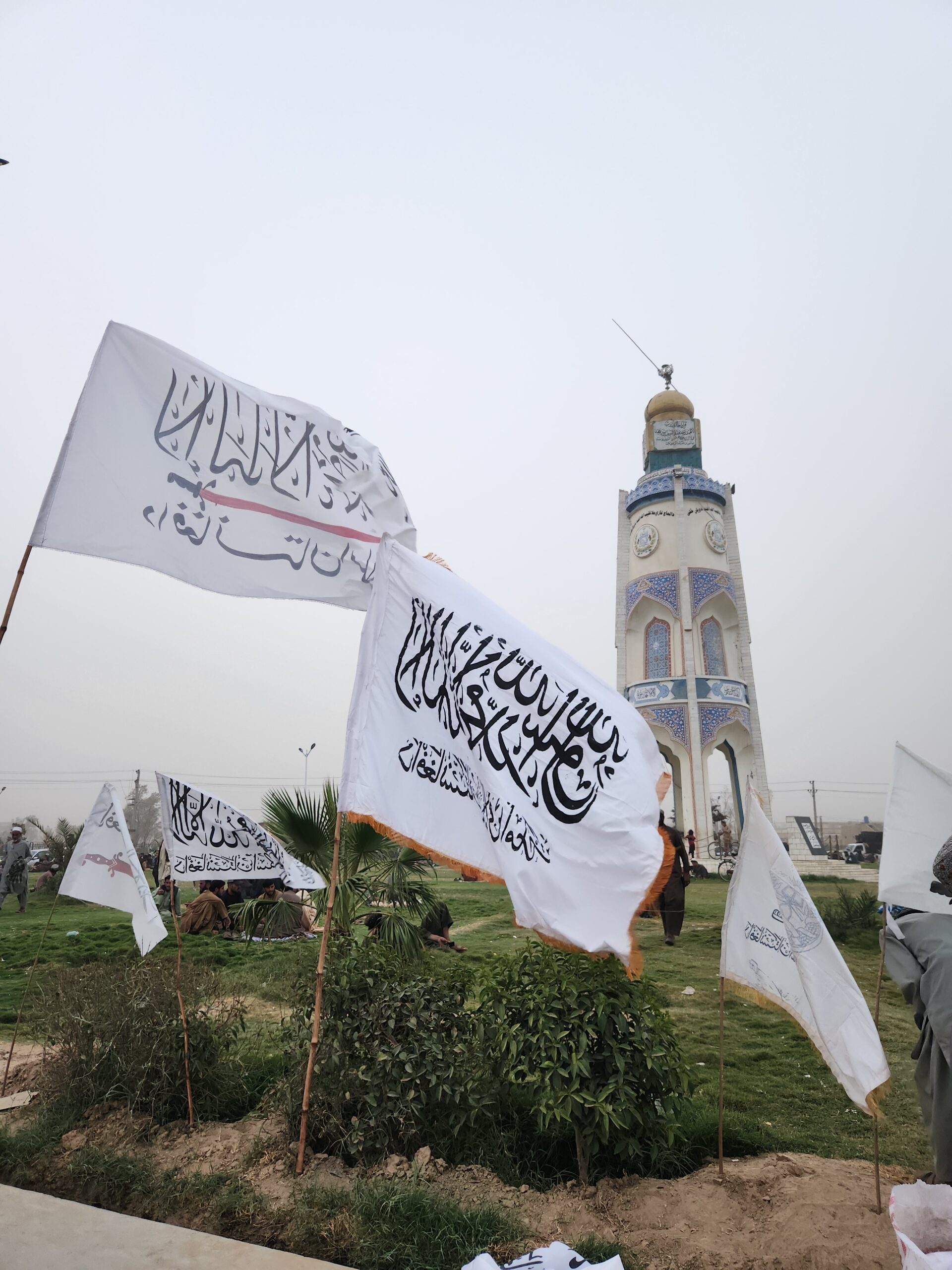
(Photo credit : Fazelminallah Qazizai 2025 )
Tower of Martyrs in Kandahar
Erected as a memorial for fighters killed during the invasion of Soviet Union, this stark monument dominates Kandahar’s skyline. Its unveiling ahead of the second anniversary of the August 15, 2021, takeover underscores the regime’s focus on legitimizing its rule through martyrdom narratives.