About the 11 February revolution
By: Abdulnasser al-Khatri
About the 11 February revolution
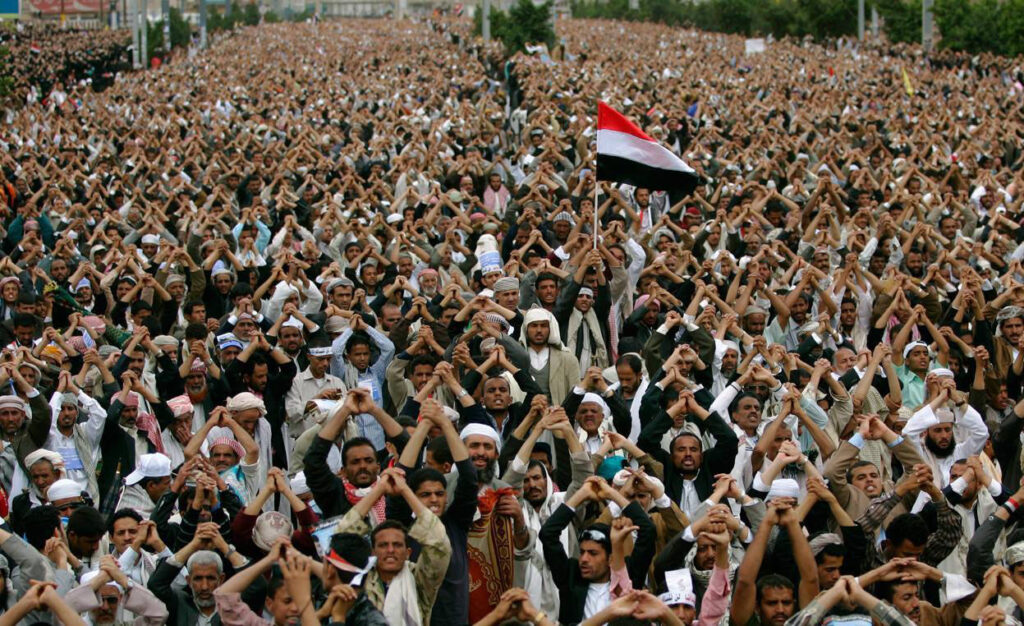
The revolution was a series of popular protests that broke out in Yemen at the beginning of 2011 and effectively lasted until Abd Rabbuh Mansur Hadi was elected president in February 2012. Sit-ins and demonstrations continued to be held from time to time until President Hadi dismantled the network of Saleh’s relatives in the army and in senior posts, as part of the restructuring of the Yemeni army. On 18 April 2013 the last tents were removed from Change Square in Sanaa, and the revolution’s organising committee announced the suspension of sit-ins and demonstrations for the first time since February 2011 [Wikipedia].
The demonstrations began on 15 January 2011, but the revolutionary forces agreed to name the revolution after 11 February, the day the fall of Egyptian president Mohamed Hosni Mubarak was announced, because on that date the demonstrations spread across the Yemeni governorates.
Why the revolution broke out
The Yemeni revolution had many causes – political, economic, social and security-related; indeed, they touched every area of life, for it was a revolution to restore dignity. Among them:
1. Political deadlock:
Through a series of crises and rigged elections, the former president sought to exclude the political forces and take sole and complete control of power. The 1993 crisis ended in the 1994 war and led to the exclusion of the Socialist Party, his partner in founding the Republic of Yemen; the 1997 elections excluded Islah, his partner in the 1994 war.
During this period and afterwards, the old army led by Saleh’s companions was dismantled, beginning with the killing of Major General Mohammed Ismail in 1999, and wars of attrition were waged in Saada from 2004 to 2010 to finish off the First Armoured Division and its commander, Major General Ali Mohsen. This left the field clear for the sons: the president appointed his son Ahmed to the Republican Guard, his nephew Yahya to the Central Security forces and the counter-terrorism unit, Ammar to National Security and Tareq to the Special Guard.
On 28 October 2010, the former president became convinced that handing the country down to his sons was ready and only a matter of time. He announced constitutional amendments that would abolish the two-term limit on the presidency and leave it open – what the member of parliament Sultan al-Barakani called “pulling out the meter” – paving the way for a presidency for life and hereditary succession. That is why the revolution broke out and raised the slogan of bringing down the regime: it could no longer be reformed.
2. Poor economic and social conditions:
United Nations sources indicate that 31.5% of the population lacked “food security”, while 12% suffered from “acute food shortages”. Some 40% of the country’s 23 million people lived below the poverty line (less than two dollars a day). The revolutionaries took to the streets to denounce unemployment and poverty and to seek a life of dignity.
3. Widespread corruption:
The Yemeni government was among the most corrupt: Yemen ranked 164th out of 182 countries in Transparency International’s 2011 corruption report, with only Iraq and Somalia ranking lower among Arab countries [Wikipedia].
Corruption pervaded every area of life and was present in all institutions, including academic and military institutions.
How the revolution turned into a crisis
No one would dispute that the 11 February revolution failed to achieve the goals and aims for which it was launched, namely the complete overthrow of the regime. All it achieved was the removal of the president himself, while his presidential and governmental system remained entirely in place. This failure had a number of domestic and external causes, which can be summarised as follows:
1. Specific domestic causes:
– The parties climbed on and rode the revolutionary wave. The former regime exploited this card in particular to stir up the feelings of the people and the vast majority of Yemenis against the dangers of parties climbing on the back of the revolution and riding its wave to achieve their own goals and agendas, especially as most of the parties had been part of the regime at earlier times.
– Some figures associated with the old regime joined the revolution. The regime skilfully turned this sudden shift to its advantage, using it to the full to wage a media war against the military and tribal figures who had joined and supported the youth revolution, casting doubt on how serious and credible they were about bringing change, and portraying the whole affair as merely a tool for settling old private scores between the pillars of one and the same regime.
2. External and international causes:
Regional and international intervention played an important and influential role in rescuing the collapsing regime and in turning the matter into a mere contrived political crisis between the pillars of the ruling regime and of the opposition. This helped the president leave the top of the ruling regime at the lowest possible cost and with full immunity, through the Gulf Initiative agreement, which was a lifeline for the regime, a temporary waiting station from which to play a hidden role in running affairs from behind the scenes, and a warrior’s rest before returning through the back door. The Gulf Initiative and the presidential election also helped split the revolutionary ranks between supporters and opponents.
The National Dialogue phase
The National Dialogue held its first session on 18 March 2013, and signs of its failure were visible from the outset. The most important were:
- Manipulation of representation quotas: some forces were represented at several times their real weight on the ground, while others were short-changed and not given their due share.
- The exclusion of some social, tribal and party components from the dialogue.
- The choice of some representatives of certain components without their being nominated by those components, as with the representatives of the South.
- Double standards in the criteria and conditions for admitting groups to the dialogue: while Ansar al-Sharia were refused representation on the grounds that they bore arms, the Houthis were admitted even though they bore arms and controlled Saada governorate. Because they were admitted while armed, their armed wing continued to expand on the ground under the umbrella of the dialogue.
- Some components entered the dialogue without accepting its frame of reference. The Houthi group rejected the Gulf Initiative while at the same time taking part in the dialogue that stemmed from that very initiative. This contradiction produced a contradiction on the ground: representatives of the group took part in the dialogue, while some of its members remained in the sit-in squares, even though the initiative provided for the sit-ins to be lifted.
Nevertheless, most of the forces taking part in the dialogue were keen for it to succeed. The conference indeed held its last session on 25 January 2014, and all signed the final document except the Houthi group, whose official spokesman declared: “We did not sign this document and consider that it offers no solution either to the southern question or to the outstanding national issues; the division was made according to political whim” (Al-Alam channel website, 10 February 2014). This was because one of the dialogue’s main outcomes was the transformation of Yemen into a federal system divided into six regions – something that did not satisfy some southern components, which wanted Yemen divided into two regions, north and south, to make secession easier in the future, nor the Houthi group, which wanted a region comprising Saada, Amran, Hajjah and al-Jawf so as to have a capital, a port and an oil resource.
The counter-revolution and the fall of Sanaa
The Houthis’ rejection of the dialogue document, together with the former regime’s – that is, the General People’s Congress party’s – rejection of some of the outcomes, above all those of the transitional justice working group, formed the nucleus and the basis of the new alliance for carrying out the counter-revolution and overturning the outcomes of the dialogue. The group stepped up its military operations on the ground with the support of the former president: the inhabitants of Dammaj were displaced, then came the advance towards Hashid, then Amran and Sanaa, and then the remaining northern governorates, on various pretexts. Here I will speak only of the fall of Sanaa, as the most important event.
At the end of August, the state decided to lift subsidies on petroleum products by more than 50%. This decision gave the Houthi group a golden opportunity to use it as a pretext for entering Sanaa: it announced its rejection of the measure and set itself up as the voice of the hungry and oppressed people.
Amid the chaos, it moved into action and mobilised its fighters from various governorates to besiege the capital, threatening to storm it if its three demands were rejected: replacing the government with a government of national partnership (one of the outcomes of the dialogue); cancelling the price increase on petroleum products (even though the increase had been approved by parliament under the former president); and implementing the outcomes of the dialogue (which it had not even signed).
Despite mediation committees – the last being the visit in person of envoy Benomar to the group’s leader – and despite the concessions, the partial reversal of the price-increase decision and the prime minister’s resignation, the group insisted on carrying out the plan it had drawn up, or that had been drawn up for it. It insisted on entering Sanaa on the pretext of bringing down the price increase, and it did indeed enter on 21 September 2014. Its targets were the First Armoured Division led by Ali Mohsen, which had supported the 11 February revolution; Al-Iman University, which had legitimised the revolution through the fatwa issued by its sheikhs; the headquarters of the Islah party and the homes of its leaders and activists, who had been the real driving force of the revolution; and the closure of Suhail TV, the only channel speaking for the revolution… In this way what remained of the 11 February revolution was finished off, every landmark recalling it was erased, and what happened on 21 September was proclaimed a revolution to replace the 11 February revolution. No observer can fail to see that this is exactly what happened in Egypt, only with different actors.
How were the Houthis able to enter Sanaa in a matter of hours?
Anyone following the Houthi movement will see that it was unable to take control of small areas in months – it failed, for example, to take control of Dammaj in three months, and its inhabitants were displaced under an agreement overseen by representatives of the state. How, then, despite this weakness, was it able to bring down the capital in a matter of hours?
The truth is that the Houthis did not bring down Sanaa on their own: there was a domestic alliance and regional and international backing. The President of the Republic expressed this in his address to the presidents, ministers and deputies of his administration on 23 September 2014, two days after the fall of Sanaa, as reported by the Yemeni news agency Saba: “I address you at this difficult moment in our Yemeni history, fully aware of the hardship of the past days. I know that you all feel shocked by what has happened and by the handing over of some state institutions and army units in the way we have seen. But you must also know that the conspiracy was beyond imagination, and that we were stabbed in the back and betrayed.” He added: “It is a conspiracy that went beyond the borders of the homeland, in which many forces allied themselves – people with interests that had been lost, and opportunists whom we see, in every calamity, feeding on the liver of this homeland.” Hadi had attacked Iran (Al-Asriya Net, 15 September 2014), saying: “We have repeatedly warned against any interference in Yemen’s internal affairs, but what is happening may be messages aimed at imposing regional hegemony and exposing Yemen to great dangers. There is evidence proving Iran’s interference in Yemen’s affairs.”
Domestically, the Houthis allied themselves with the former regime and its military wings, as the Houthis’ spokesman acknowledged on Al Jazeera. The recent Security Council decision imposing sanctions on the former president and on Houthi leaders also shows that this alliance is recognised both at home and abroad.
External support took the form of a regional and international wish to exclude Sunni political Islam from the seat of decision-making. There is no clearer sign of approval and support than the fact that all embassies remained open before and after the fall of Sanaa. Indeed, support was voiced openly: Iranian statements after the fall of Sanaa described what had happened as an extension of the Iranian Islamic revolution, and the United States appeared directly, its aircraft fighting alongside the Houthis in their war against the tribes in Rada‘a, on the pretext of fighting terrorism. All the facts thus confirm that the Houthi militias were merely tools for carrying out a plan aimed at striking the national forces known as the “traditional forces”.
The Peace and Partnership Agreement
In the shock of the moment, on the very day Sanaa fell, 21 September 2014, the political forces signed an agreement known as the “Peace and National Partnership Agreement”, in the hope of pulling the country out of the spiral of violence. The Houthis were intransigent over the signing, to the point of refusing to sign its security annex, which was signed a week after the agreement itself.
The agreement was a political victory for the Houthis, who regarded it as cancelling the Gulf Initiative they had rejected. Their spokesman declared that the Gulf Initiative was over for good, stating that the Peace and Partnership Agreement documented a political contract with a new political partnership based on the outcomes of the Dialogue Conference and responding to popular demands (Naba Online, 25 April 2014). Moreover, the regional and international community blessed the agreement without the slightest condemnation of or sanction for what had happened, even though UN Security Council Resolution 2140 of 17 February 2014 placed those obstructing the political process under Chapter VII – although we did not wish for that resolution or for international tutelage. The resolution appeared to target one particular faction, which was expected to stand up to the group! But that faction grasped the scale of the conspiracy and withdrew in silence. Then came the recent sanctions decision against the former president and Houthi leaders, as a way of throwing dust in people’s eyes; it will not affect the course of events, and some see it as a punishment of Yemenis rather than of those obstructing the process.
More than a month and a half has passed since the agreement was signed, without any real progress on the ground. The agreement is still “ink on paper”, while the Houthi group expands militarily in a number of governorates – notably Hodeidah and Hajjah (in the west) and Ibb and Dhamar (in the centre of the country) – and tries to expand in al-Bayda; its militias are still deployed in the streets of the capital, Sanaa. Of the agreement’s provisions, only the appointment of advisers to the president and the formation of the government have been implemented, and the government is still under review by the group. Observers believe it will be something like a “shadow government”, given the Houthi expansion within Yemeni cities and the group’s rejection of all agreements requiring its fighters to leave the capital and the other governorates.
Future repercussions
With the fall of Sanaa, the country fell into the furnace of chaos and open violence. The country is living in a state of statelessness. With the state absent, militias playing its role and the political forces withdrawing from confronting the group, the role of the tribes opposed to the Houthi presence in their areas has grown: several alliances have been formed among tribes in al-Bayda, Marib, al-Jawf and elsewhere. This suggests that the country may enter conflicts with a beginning but no end, unless God wills otherwise.
The role of al-Qaeda (“Ansar al-Sharia”) has also grown in confronting the group in the areas the group targets on the pretext of fighting terrorism. This has created popular sympathy and an incubating environment for al-Qaeda in many areas, especially given the support of US aircraft for the Houthis.
Eliminating al-Qaeda has become difficult while other armed groups impose their control and expand by force of arms at the expense of state sovereignty. Violent groups complement one another: each draws its strength from the survival of the others and, before that, from the absence of the state.
The fall of Sanaa to the Houthi militia has also revived the southern question, and voices calling for secession have risen again after fading during and after the dialogue. The southerners’ sit-in in Aden has continued from 14 October 2014 to this day.
On the other hand, some of the forces allied with the Houthis at home, and some of the forces that supported them from abroad at one time, have begun to sense the danger of what they have done, as the Houthi expansion has gone further than was planned for it. This suggests that the country may soon witness a conflict between allies at home – indeed, it may turn into an arena of regional and international conflict!
To find a way out of all this, we must work hard to build a state of institutions, push for the implementation of the outcomes of the National Dialogue and of the agreements that followed, such as the Peace and Partnership Agreement, and raise public awareness of the values of coexistence and acceptance of the other, within a state of institutions that treats everyone according to a constitution, a system and a law that everyone helps to draw up.
By: Abdulnasser al-Khatri
Paper presented at the eighth meeting of the Cordoba Now Forum