The minaret is stirring an ever more heated debate in Switzerland. For several months I have refrained from writing about this architectural feature that adorns the mosque, thinking that the controversy it arouses would die down after a while. Alas, that has not happened. Last week politicians of the nationalist right launched a federal popular initiative “against the construction of minarets”. I therefore think it useful to contribute a few clarifications about minarets to the debate.
How many interpretations have been put forward of the symbolism of the minaret!
Its defenders claim that it symbolises the number 1, referring to the oneness of God, or that it has the shape of the letter alif, the first of the Arabic alphabet, underlining the place of knowledge in the mosque. Others see it as a pointer directed towards Heaven, a constant reminder of the presence of the One.
Its detractors see it as a sign of power indicating the aggressive character of Islam, or as a phallic symbol reflecting a patriarchal culture that perpetuates the submission of women; some cartoonists even see it as a missile aimed at the West.
Federal Councillor Christoph Blocher saw fit to intervene in the debate on minarets, describing them in the columns of Le Matin Dimanche (6 May 2007) as “signs of domination” and questioning “their place in a Christian country like Switzerland”, while nevertheless pointing out that “the Confederation does not recognise any religion as a state religion.”
Mr Blocher is right to think that the gigantism and excessive height of a building can carry a message of overwhelming power and domination. Historians of architecture explain how the imposing size of official buildings in various civilisations, from Antiquity to the modern era, was meant to impress the individual and instil in him submission to the political or religious order. However, Mr Blocher is plainly mistaken in drawing an inference about the minaret without taking the trouble to inform himself about its history and its functions in the city.
It should be noted that the minaret did not exist in mosques during almost the whole of the first century of Islam. When the construction of the first mosque in Muslim history was completed in Medina, a discussion took place between the Prophet and his companions on how to make the call to prayer (adhan). Several solutions were suggested, including the bell of the Christians and the horn of the Jews. In the end it was the human voice that was adopted. Bilal the Abyssinian, newly freed from slavery, was honoured by being chosen by the Prophet to call the first adhan from the roof of the mosque. He was the first muezzin of Islam.
Historians date the appearance of the first minarets to some 80 years after the death of the Prophet, notably in Damascus, where the Umayyad dynasty reigned. Specialists in Islamic architecture point to the influence of the Byzantine churches of Syria on the design of mosques, the minaret being the counterpart of the bell tower. That may be why in some regions of the Arab world, notably the Maghreb, the minaret is called sawma‘a, a term that also denotes a hermitage or monastery.
Originally, equipped with torches, the first minarets served to light up the surroundings of mosques. The word minaret in fact comes from the Arabic word manara, derived from nur (light); the minaret thus literally means lighthouse. Moreover, like a watchtower or crier’s tower, the minaret gave the muezzin a vantage point from which to carry his voice as far as possible in ever larger urban areas. Hence the minaret is also called mi’dhana in Arabic: the place of the call to prayer.
Clearly, with the arrival of loudspeakers, the muezzin no longer needed to climb to the top of the minaret. The minaret lost more of its functional usefulness with the development of street lighting and of technical means that allow believers to be notified of prayer times in a highly personalised way (computers, mobile phones, quartz watches, etc.).
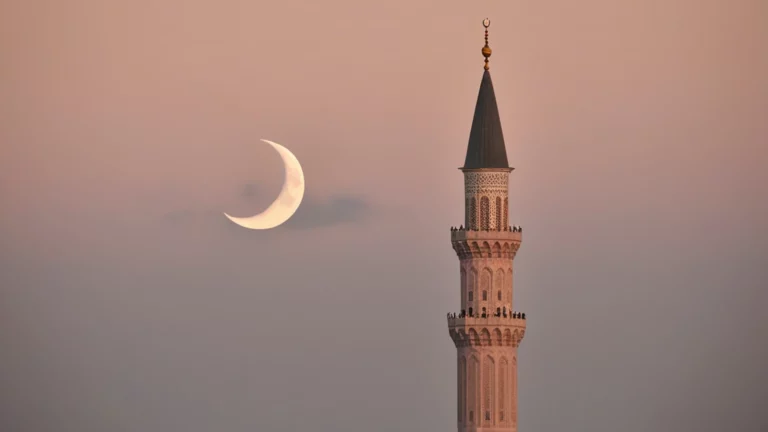
Yet the minaret retains its full aesthetic dimension. Slender and elegant, harmoniously integrated into local architectural traditions all over the world, far from inspiring a feeling of domination, it is perceived as a source of light, both physical and spiritual. It is associated with prayer, or salat (from sila), signifying the permanent bond between the human being and the Source of Light (al-Nur), which is one of the attributes of the Creator. It is this bond that allows spiritual renewal.
The conflicts generated by mosque construction projects in Switzerland should be dealt with at local level, in a climate of trust and good neighbourliness, far from all passion. The Muslim religion does not require a mosque to have a minaret, still less does it prescribe its size or shape. Those who wish to build a mosque with a minaret will be able to devise the most appropriate architecture, taking into account, of course, town-planning requirements and the wishes of their neighbours and fellow citizens.
If secularism rightly does not allow religion to interfere in the affairs of the state, no more does it authorise the state to meddle in the management of worship down to the smallest detail. As for those who wonder about the place of the minaret “in a Christian country like Switzerland”, what then would we say if, by reciprocity, Muslim countries were to ban churches on their soil, some of which are, moreover, architectural masterpieces?
Some, alas, wish to turn a banal subject into a matter of “national security”, often for narrow political ends. By their irresponsible attitudes and behaviour they arouse among non-Muslims the instinct of fear and rejection, and strengthen among Muslims the feeling of denial and frustration. Do they even measure the risk they are creating for social harmony in this country? When will they realise that neither fear nor frustration is desirable if one cares about preserving a model of society founded on respect, cohesion and solidarity among citizens?
Abbas Aroua, Director of the Cordoba Foundation of Geneva (CFG), 7 May 2007
Deutsche: Das Minarett in der Schweiz: Konflikterzeuger oder Lichtquelle?