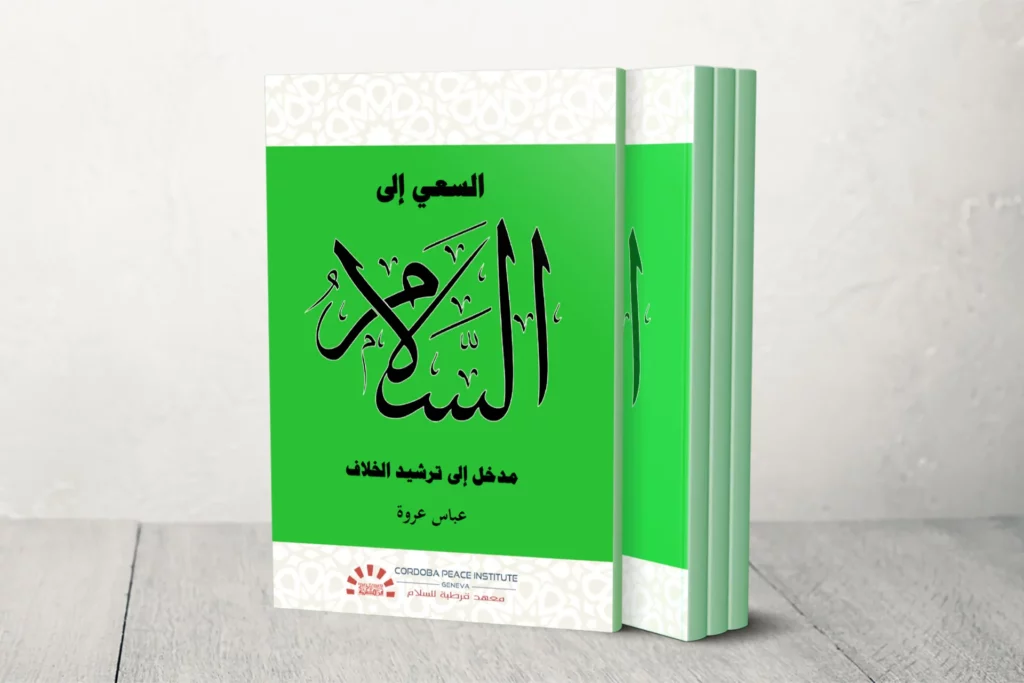
At a time when disagreement has become a source of tension and resentment, Cordoba Peace Institute – Geneva has published The Quest for Peace: An Introduction to Conflict Transformation by Dr Abbas Aroua, a Privatdozent at the Faculty of Medicine in Lausanne, Switzerland. Dr Aroua is an expert in medical physics, health physics and radiation protection, and the founding director of Cordoba Peace Institute – Geneva, which specialises in violence prevention, conflict transformation, peacebuilding and the strengthening of social cohesion.
The book, 360 pages in medium format, comprises an introduction and 16 chapters arranged in five parts. In it, Dr Aroua dwells on essential pillars such as uncovering the truth, preserving memory, achieving justice and practising forgiveness. Among the questions it discusses are the tension between the right to freedom of opinion and expression and the right to respect for the sacred, as well as conflicts rooted in values. The book also examines value systems and the process of changing attitudes and behaviour, and the interaction of religion with attitudes, orientations and behaviour, shedding light on the ways in which religion is linked to conflict.
When disagreement turns into a negative interaction, it ends up shaking society and fracturing its components. The first sign of such negative handling of disagreement is acute polarisation, which demonises the other and turns them into an adversary and an enemy instead of treating them as a genuine partner.
The book is a real addition to the Arab and Islamic library, since the science of conflict transformation is a quintessentially Western discipline: it is taught in many universities, centres are founded for it and the necessary resources are devoted to research in it. According to Dr Aroua, we must understand why the Muslim world is absent from this vital field of knowledge, “even though the Holy Qur’an, the noble Sunna of the Prophet and the lives of the scholars and righteous people of the Umma contain values, principles, guidance and practical examples that make it possible to develop a comprehensive and applicable theory of violence prevention, dealing with conflict, managing it well and promoting peace”.
It should be borne in mind that this book appears at a time when many peoples live under the yoke of regimes that lack legitimacy and are marked by authoritarianism, repression and corruption. Instead of fulfilling their basic task of meeting their citizens’ essential needs, above all food, peace and security, these regimes are concerned only with seizing political power and monopolising the nation’s wealth.
The book stresses the need to transform conflict in times of peace as in times of war, recalling that disagreement is a human necessity arising from differences in frames of reference and in goals. It is natural for human societies to include different currents reflecting human richness, intellectual diversity and freedom of belief. Anyone who follows the course of history will see that whenever divergent views interact in a positive and healthy way, they end up serving the common good and giving society and the state steady, visible growth.
Yet when disagreement turns into a negative interaction, it ends up shaking society and fracturing its components. The first sign of such negative handling of disagreement is acute polarisation, which demonises the other and turns them into an adversary and an enemy instead of treating them as a genuine partner. Here the book attributes polarisation to authoritarian regimes, which constantly entrench religious, intellectual, ethnic and linguistic divisions in order to control the joints of society.
The book also points to the absence of the conditions for building mutual trust, together with the entrenchment of negative stereotypes of the other, which lead to violence, spread hatred and deepen resentment in order to tear society apart and fragment it, in line with the messages constantly broadcast by official and semi-official propaganda, as well as by regional channels and outlets with populist or extremist content.
Among the book’s most important themes are questions of transition and the confusion, turmoil and loss of bearings that accompany periods of transition. Under despotic regimes, contradictions remain hidden and disagreements stay latent; but when the hour of change comes and a climate of freedom sets in, society sheds its fear, and those with interests, rights and needs come forward to claim them.
According to the book, periods of transformation and democratic transition are fragile and fraught with risk, for the state is then at its weakest, threatened by disagreements that can breed violence. The book notes that during transitions, internal and external actors often help to stoke disagreements and push them into the furnace of conflict in order to derail the democratic transition.
The book explains that the greatest challenge of the transitional phase is that those in charge must deal with the past, the present and the future all at once. They must deal with the present by meeting citizens’ basic needs, through the production, protection and fair distribution of wealth, and by protecting and promoting the identity components of individuals and groups. They must deal with the distant and recent past by launching genuine reconciliation. And they must deal with the future by building institutions and strengthening their role. Different societies may take different paths of political change, moving from the weight of despotic regimes to the openness of the rule of law and good governance; and some of these paths, the book notes, are more effective than others.
It is, however, very important that a society going through transition and reconciliation should know exactly what happened, and who did what, during the dark period of its distant or recent history; bringing the truth to light has a powerful effect that can help heal society’s wounds. As the book puts it, “if the truth is a right of the individual, especially of the victim and their family, it is also a duty of every member of society”.
In transitional phases, according to Dr Aroua, it is necessary to recall the injustices that occurred, and also to recall the need to raise the banners of justice. Here the importance of memory in Islam comes to the fore, closely linked as it is to remembrance, whose educational virtues the Holy Qur’an emphasises: “And remind, for the reminder benefits the believers” [Al-Dhariyat: 55].
In the Qur’an, remembrance is seen as a mark of intelligence: “Only those endowed with understanding take heed” [Al-Ra‘d: 19]. From here the book turns to the concept of transitional justice, which it defines as the set of approaches that states can use to address serious human rights violations, comprising judicial and non-judicial measures; in the book’s words, it is a set of policies, procedures and institutions that may be enacted during a political transition from a period of violence and repression to one of firmly established political stability. Among the most important conditions for successful transitions and transitional justice is to lay out the facts and give them precedence over everything else. In a Muslim society, everyone is expected to help uncover and discover the truth, for concealing it is one of the gravest sins. God says: “And do not mix the truth with falsehood, nor conceal the truth while you know it” [Al-Baqara: 42]; and scholars hold that one who keeps silent about the truth is a mute devil, and one who speaks falsehood a speaking devil.
Effective reconciliation is essential, and effective reconciliation requires successful mediation. The aims of mediation are to break the sharpness of the parties’ positions towards one another and to build trust, so as to transform their disagreements into positive, constructive ones.
The book holds that Islam opens wide possibilities for joint action for the common good and, in the governance of the city or state, provides a framework that offers guidance while leaving room for creativity. Referring to the covenant concluded in the Prophet’s city, peace be upon him, the book says that “the Charter of Medina is practical proof, from an Islamic perspective, of the possibility of coexistence and positive interaction in a society of multiple tribal and religious affiliations. This charter, which has been called the first constitutional document in human history, succeeded in doing so by introducing a new concept of social belonging made up of three different layers: the tribe, recognised as a social reality; social belonging to religion, which involves a system of shared values; and belonging to the city”.
Effective reconciliation is also essential, and effective reconciliation requires successful mediation: it is necessary to consult actors on every front and in every sector and group, whether legal, social, religious or educational. The aims of mediation include breaking the sharpness of the parties’ positions towards one another and building trust, so as to transform their disagreements into positive, constructive ones, as well as exploring ways of easing acute sectarian and ideological tensions. Cooperation is needed to achieve peaceful coexistence: according to the author, acute polarisation in fragile contexts of political transition often leads to chaos, paving the way for the return of despotic regimes or for civil strife. Emphasis must also be placed on producing a new, shared political culture based on the values of freedom, justice, dignity, diversity, acceptance of the other, non-exclusion, citizenship and the rejection of violence, by building trust at a time when disagreement has become a source of tension and resentment. Coalitions that cut across sects and ideologies must also be built, which can help bring peaceful political transition to success in countries going through transitional phases.
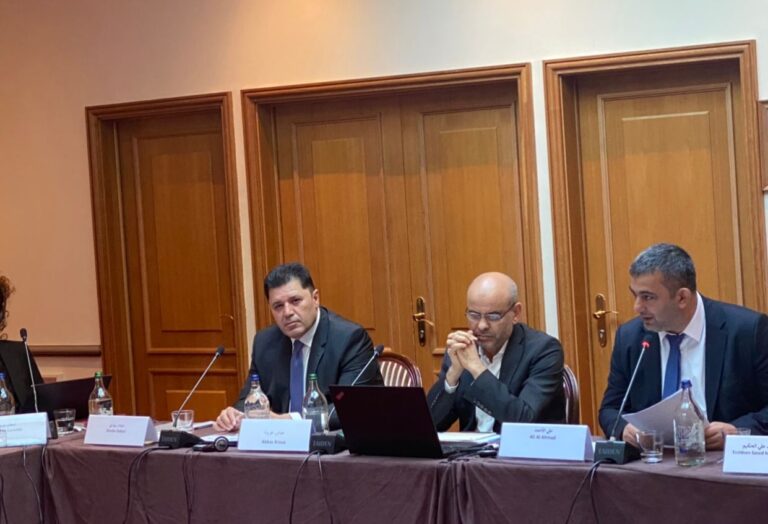
At a workshop organised by Cordoba Peace Institute – Geneva and hosted in Morocco, participants concluded that polarisation between Islamists and secularists needed to be reduced, and that all parties should move beyond philosophical debate and focus on the need for joint action for the common good, to strengthen society and build the state. This should take place within a fair framework and a “common space” that requires no party to give up its intellectual frame of reference or betray its cause. Such a framework for joint action and collective effort can be grounded in the religious and ideological references of all parties. Groups with different foundations in their value systems and worldviews can thus choose to engage in joint action with other groups, each for its own reasons. In this way, different groups can live together in a common space, each finding the justification and motivation to do so in its own system of rules and guiding principles. The American philosopher John Rawls calls such joint engagement of different groups interacting within the same space an “overlapping consensus”.
In this valuable book, Dr Aroua writes that addressing the tensions that shake the Arab and Muslim worlds and hamper human development there “requires training a broad elite of specialists in conflict analysis and transformation, familiar with the Arab and Islamic traditions in this field, experienced in the techniques developed in the West, and able to adapt them to Arab and Muslim societies, taking into account the historical context, the realities and the social particularities of these societies”.
Dr Aroua points out that while dozens of research and study centres and programmes have spread across the Western world to deal scientifically with the phenomenon of conflict and the means of resolving and transforming it into an active force and a positive mechanism for developing society, the Arab and Muslim world has almost none. At best, those who deal with questions of conflict and peace turn to Western expertise that applies recipes prepared in a cultural space different from the Arab and Islamic traditions.
In conclusion, The Quest for Peace: An Introduction to Conflict Transformation is a rich book, original in its approach and new in its material. We hope it will encourage academic circles and civil society organisations in Arab and Muslim countries to build on the solid foundation that Dr Abbas Aroua has laid for this branch of knowledge, with its positive impact on society.
Writer and novelist. His novel The Bitter Blackness (Al-Sawad al-Murr) has been included in the academic curriculum for political science students at Grand Valley State University in the United States.
Source: Al Jazeera Net (external website, opens in a new tab), opinion pieces
CPI is not responsible for the content of external websites.