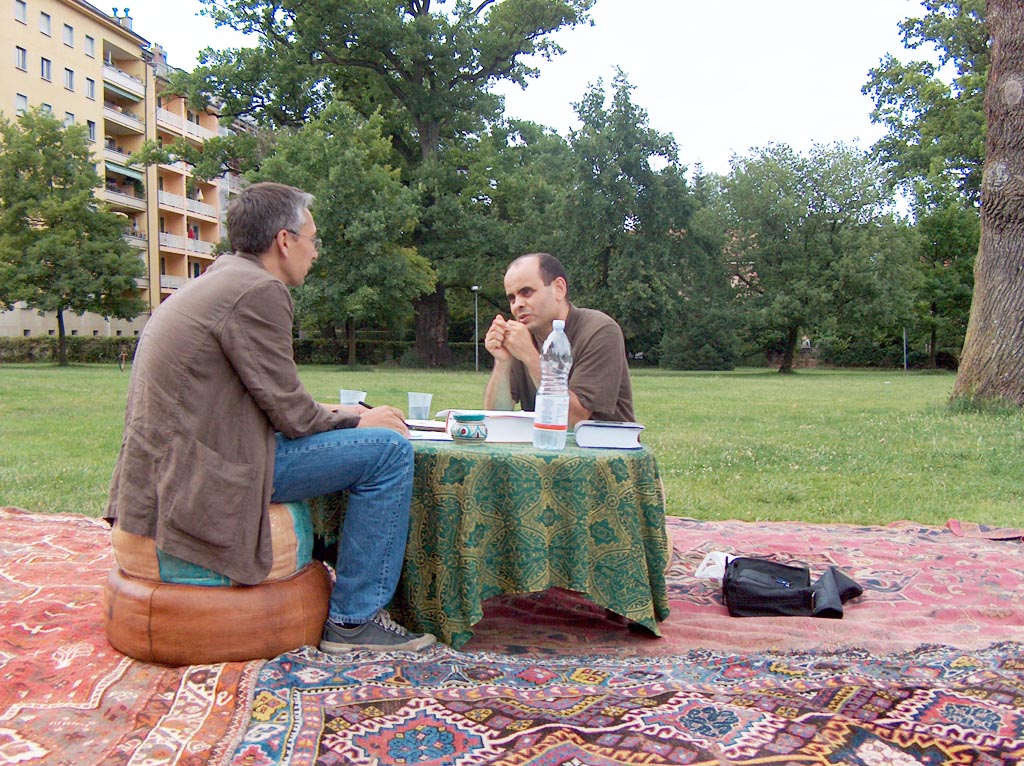
– Islam and democracy, A. Benarafa
– Does Islam pose a threat to democracy?, G. M. Arnaout
– Is Islam compatible with human rights?, H. Manna
Islam and democracy Posing the problem in this way has at least one pedagogical virtue: it answers the question of the relationship between Islam and democracy. The other side of the coin is that this presentation risks creating confusion in the listener’s or reader’s mind about the possible relationship between a religion (in this case Islam) and a political system (democracy). We must beware of the tendency to arrange problems into artificial oppositions and antitheses through an interpretation that is both simplistic and systematic, and that above all reflects an inability to go further and to resolve apparent oppositions in the harmonious unity of a genuine synthesis.
It is nonetheless true that, in the relationship we are considering here under the title of this symposium, there is a certain superficial opposition between Islam and democracy. How, then, can we better understand the two terms of this question? In my view, we must first set out simply what Islam is on the one hand and what democracy is on the other, in order to gather the elements of divergence or agreement between them. Taken separately, these two concepts pose no problem. Each obeys its own logic. But placed side by side, they raise the question of their possible relationship. Let us return, then, to some fundamental questions: What is Islam? What is democracy? Many works have been devoted to answering these questions. Some take historical, sociological, psychological, political or doctrinal approaches. The word “islam” appeared in the Arabic language at the same time as the revelation. As for the word “democracy”, of Greek origin, it entered the Arabic language in the modern period. Islam and democracy denote too many things to be grasped at once in a relationship of opposition or complementarity. They must therefore be reduced to their simplest expression. What is democracy, put simply? Here is the definition given by the Robert dictionary: “A political doctrine according to which sovereignty must belong to the whole body of citizens.” This very simple definition raises a number of problems concerning the definition of sovereignty and of citizens. But that is not our subject. On the other side, what is Islam? According to a very famous hadith (saying of the Prophet), reported by Abu Hurayra, the Prophet was one day with his companions when a man came, dressed in white, with intensely black hair, and asked him: “What is Islam?” The Prophet replied: “Islam is that you believe in God without associating anything with Him, that you perform the prayer, that you pay the obligatory alms, that you fast during Ramadan, and that you make the pilgrimage to the House of God once in your life…” Such are these two concepts reduced to their simplest expression. Our concern is to know whether the two terms can be brought together. Broadly speaking, according to this hadith Islam denotes a certain number of “duties”, while democracy denotes a set of “rights”. Some would be tempted to conclude that the two concepts are irreducibly opposed. Yet this formulation of the problem is counterproductive. Democracy, like Islam, suffers from an excess of meaning. But this semantic inflation also reflects the vitality of the two terms, which take on the colours of human representations. Concepts with a universal vocation are by nature either too loaded or too simple – hence the difficulty of grasping them by emphasising one side or the other. A universal concept meets a twofold requirement: it has a very simple conceptual bareness and at the same time carries the semantic weight of human translations – above all when the concept in question has a vocation of salvation for humanity. Democracy is not only an organisation of institutions; it is above all a moral requirement. And this requirement is not merely an abstract formulation: its content is determined by the space and time in which it is applied. There is thus a dynamism that carries meaning in a concept such as this. Wanting to lock democracy into a single definition without the variables of time and space would result in a dead notion. All of history proves that democracy achieved is only ever one moment of the democratic movement, and this movement seems to have no end, since democracy seeks to bring about the good – and the good is necessarily a quest that never stops unless death overtakes us. Democracy is thus certainly not only a mode of political organisation; it is a value. And this value cannot be imprinted outside each individual. It is the outcome of a culture, the crowning of human genius – that is, a human elevation at the level of the person and of others. The Declaration of the Rights of Man and of the Citizen, for example, is the crowning of French and European culture. Democracy is therefore a value between two mediocrities: below it, the lack of democracy leads to slavery; above it, to despotism. Democracy is thus a value of the golden mean, the most solemn affirmation between two negations of human freedom. The slave suffers from a deficit of personality, the despot from an excess of his own. The first ignores the consciousness of his self, the second the face of the other. Democracy therefore has the vocation of eliminating human servility and despotism. Let us now consider the relationship of Islam to democracy. Why not speak of Muslim democracy, as one speaks of Christian democracy? Nothing fundamental prevents such a political form. Islamic democracy therefore presupposes that Islam is concerned with the happiness of oneself and of others in a way compatible with democracy as we have described it. But before considering whether Islam is compatible with democracy, let us see how this religion treats the two opposite anti-democratic tendencies, namely slavery and despotism. Islam was born in a slave-owning and despotic society, as the Arabian Peninsula was – like, indeed, the whole world at that time. The Qur’an and the prophetic tradition constantly proclaimed the universal value of human freedom, which proceeds from the divine. Man is not a rational animal; he is God’s vicegerent on earth, meaning that he is responsible for all creatures. This implies that man is not alone in the universe: he has a right of oversight and duties of protection towards all creatures. He is not an isolated individual cut off from the rest. Islam produced a countless array of measures to reduce slavery, even to eliminate it, without fully succeeding, since men are what they have been since the world began. They were not yet ready to give up enslaving their fellows – something that continues today in other forms. As for the other tendency, despotism, it is incompatible with the Qur’anic and prophetic message. The figure of Pharaoh, symbol of the despot, is portrayed very negatively in the Qur’an. The Prophet himself was a very simple man who consulted his companions, sometimes on details of daily life, in order to preserve this spirit of consultation and collegiality. If, then, there is an Islamic democratic tradition, it must not be sought in a universal declaration of human rights, or in a constitutional text proclaiming that the people are sovereign, since the Qur’an does not have that vocation – which is, after all, limited and subject to the vagaries of change. According to Dr Abdulaziz bin Othman Altwaijri: “Although it holds a comprehensive system of life, Islam has not proposed precise and detailed rules for the mode of government of the State and its economic, social and administrative arrangements. It has confined itself to decreeing general principles, legal provisions and guidelines, the observance of which leads straight to salvation and felicity in this world and the hereafter. Indeed, Islam has guaranteed man the freedom of thought that allows him to build theories and devise plans of action for managing his life and the affairs of the State and society, in conformity with the general prescriptions of religion” (Political Education in Islam, ISESCO 2001, pp. 33–34). The Qur’an is a revelation with a universal, eternal vocation that admits no amendment of any kind. This Islamic democratic tradition must be sought in the spirit of Islam as a democratic movement. When an idea is universal, it is necessarily compatible with Islam. When an idea is true in one universal tradition, it is necessarily true in the other traditions with the same claims. If an idea is true, it belongs equally to all who are capable of understanding it and making it their own. If it is false, there is no glory in having invented it. A true idea cannot be new, for truth is not a product of the human mind; it exists independently of us, and we have only to know it – outside this knowledge there can only be error. Freedom and democracy are among these true and universal ideas. Democracy is a universal idea in its relationship to freedom, but it becomes relative in the way that freedom is organised in different human societies. Islam, as a perennial religion, is universal. But its human translation is relative and subject to change. The different conceptions of democracy fall between two broad tendencies: man is regarded either as a citizen granted certain political rights, or as part of a class granted social guarantees. This is a horizontal relationship. Islam, however, considers man in his relationship to God. Here the relationship is vertical, with the principle “We have honoured the children of Adam”, as a verse says that solemnly proclaims the transcendent value of humanity. This is another way of considering democracy. We can therefore say that this conception is of a sacred order, whereas Western democracy is of a secular type. Islamic democracy sees in every human being the imprint of God; the other conception sees in him the presence of other human beings and of society. The difference lies in what each person’s conscience and the face of the other mean to him. For the Qur’anic message, man must carry within him this honour with which God has graced him, for himself and for his fellows. Now democracy, as we defined it above, is a notion midway between two negations of freedom. By proclaiming honour in oneself and in others, the Islamic conception neutralises the tendencies in man that destroy freedom. This conception of freedom and democracy is, of course, protected by safeguards that prevent it from falling into the abyss of either slavery or despotism. Many verses insist on eternal salvation for those who do not seek to dominate others. Others again stress the ontological refusal of slavery, since God urges people to refuse such servility by prompting them to emigrate to God’s vast earth to escape this inhuman condition. The message of Islam thus contains all the ingredients against the extreme anti-democratic tendencies of slavery and despotism. These principles are inscribed in the faith proclaimed at every stage of the rites of passage in the life of every Muslim. Islamic democracy is thus inscribed in the intimate consciousness of oneself and of others. We have come to define democracy as a notion of the golden mean; and Islam presents itself as a religion in search of the centre. According to the history of science, language tells us that the centre of the circle, or the centre in general – that pure ideal – far from originally designating the calm place where one debates in serene democratic equality, describes the mark left by the point of the compass. Of two people who contradict each other, one must be wrong and the other right: there is no third possibility – the third is excluded, as they say; or better still, there is no middle. The dictionary defines this word as “the part of a thing that is equidistant from its edges; the middle of a street, the point halfway between its ends”. It is an almost absent point, since it is an isthmus without thickness or any dimension; and yet, suddenly, it becomes the whole volume in which we live: our milieu, that is, our environment. From the mid-place, a tiny excluded locality, to the milieu as the universe around us. What had no place takes up all of it. From the mid-place, a spot roughly equidistant from a beginning and an end, to the material space in which a body is placed. We pass from equidistance to envelopment. Islam presents itself, according to verse 143 – the numerical middle of Sura II (The Cow), with its 286 verses – as follows: “Thus have We made you a community of the middle way, that you may be witnesses over humankind, and the Messenger a witness over you…” Mecca thus becomes the centre of the world, and this declaration comes between two passages concerning the new qibla for prayer. This new orientation in space is also accompanied by a new orientation of human salvation in the middle between two extremes: servility and paganism. This is the new message of Islam: freedom and knowledge. There is no freedom without knowledge, and knowledge has no value unless it leads to making man free. We can now see more clearly the link between Islam and democracy. It was difficult to define their relationship at the start of this talk by taking them as antitheses. These two great ideas are not simple notions to be defined in a dictionary; they extend into the mental and social structures of human beings. What Islam and democracy have in common is this concern to eliminate anti-democratic tendencies, in the language of democracy, or diabolical tendencies, in the figurative language of the Qur’an. In conclusion, it seems to me that the democratic enterprise goes beyond the mere transfer of power under a given constitution, to emphasise the human desire for freedom and knowledge. A strong psychological structure is needed for democracy to be translated into institutions. Hence the mistake some make in wanting to plant democracy in a given society by endowing it with a constitution copied from the experience of another human society. Democracy must be born in the soil particular to each culture if it is to bear its fruits of freedom and knowledge. Contribution to the Tent of Dialogue
Abdelillah Benarafa, expert at the Islamic Educational, Scientific and Cultural Organization (ISESCO)Lire l’article
Cordoba Foundation of Geneva (CFG)
Geneva, 26 June 2004
Does Islam pose a threat to democracy? Excellencies, It is a privilege for me to take part this evening in an exceptional event, held under the sign of dialogue and openness to the other. How could one fail to appreciate the joint initiative of the Fondation de l’Entre-Connaissance and the Cordoba Foundation in Geneva in bringing together, not without a certain boldness, personalities of different persuasions and cultural and political sensibilities, in an attempt to build bridges between them that can strengthen the cohesion and solidarity of all the components of the great Geneva community? The exchanges and discussions that have already begun, and that will follow in the coming days, are no doubt linked to the events dominating the news. They are nonetheless part of a very Genevan tradition. They are indeed the perfect reflection and expression of what is called “the spirit of Geneva”: the deep conviction that Geneva, humanist and humanitarian, beyond its well-rooted European and Christian tradition, is aware of and attaches great importance to its universalist vocation. It is here, indeed, that people from here and from elsewhere try to show, through an almost harmonious and exemplary cohabitation, that a better world is not an illusion of the mind, a utopia, the fantasy of a few dreamy intellectuals with no grip on reality. Tomorrow’s world will no doubt be today’s Geneva: a fraternal, multicultural and multireligious world, tolerant and peaceful, allowing people of different origins to live together in conviviality and with respect for cultural diversity and the laws of the Republic. What could be more legitimate and more natural than that the Muslims of Geneva, citizens of this country or temporary residents, should feel moved, in these painful and difficult times, to reach out to the non-Muslims they rub shoulders with in their daily lives, to reaffirm their unshakeable faith in respect for the values and principles of the Republic, and to proclaim aloud their wish to dispel any misunderstanding liable to arouse, if not a certain suspicion, at least some questions about them? The vast majority of the Muslims of Geneva, whether of Arab, Turkish, Albanian, Kurdish or other origin, were born and grew up in secular states where politics is beyond the reach of religion. They also come from multicultural and multireligious countries in which, for centuries, coexistence and dialogue have never been interrupted. In this respect I would particularly like to mention our brothers, the Christians of the East – those Christians who, through their genius and dedication, contributed to building our great Muslim civilisation, and whose role, at the time of the “nahda” and in the contemporary period, has been decisive in our attempt to overcome the difficulties we face. Some of them have chosen this evening to join us, and I wish to welcome their presence. The Christians of the East today feel, like all of us, a great sense of relief. The confrontation between Islam and Christianity has not taken place. I shall not return to the clash of civilisations thesis developed by certain prophets of doom. The war launched against Iraq, after the one directed against Afghanistan, by a US administration increasingly pervaded by religiosity and using religious concepts to justify its military ventures, risked setting off the powder keg, insofar as it could appear to be a new crusade against Islam. Fortunately, everything was done to prevent this global catastrophe from happening. In this happy development a special place must be reserved for the Christian churches of all denominations and for the role played by Pope John Paul II, to whom a heartfelt tribute is due. Credit also goes to Germany and France, the two main beacons of Western and Christian culture and civilisation. These two nations, once colonialist and imperialist and now allies after centuries of fratricidal confrontation, by opposing the war clearly signalled their intention to turn away from power – or, more precisely, to move towards a beyond of power, towards a world distinct from the previous one, governed by law and by negotiation between nations, the aim being to reach through this new approach the post-historical paradise where all is peace and prosperity, as envisaged by the Kantian ideal of “perpetual peace”. In rejecting war as a solution to conflicts, the governments of France, Germany and Belgium and the churches of all denominations received the massive and active support of “global civil society”. Millions of people in Asia, Europe, Africa and the Americas took to the streets to express their attachment to peace and their rejection of the present international system, seen as unipolar and subject to the hegemony of a single great power. Those who belong to this emerging global society plead for multicultural values to be promoted, for concrete support for democracy, and for recognition of its superiority over everything that can divide human beings. In our post-modern world, marked among other things by the crisis of sovereignty, the return of religion and the globalised economy, the salvation of humanity rests on the imperative need to develop a political theory of coexistence. Living together presupposes a common living space, in the context of an accepted history, shared values and guaranteed legal rules. It is true that the world currently presents itself as a juxtaposition of sovereign and autonomous political entities, or even of distinct civilisations or cultures, leading to identity wars or to divergent assessments by the great powers of the planet’s major challenges. Yet everything tends to show that the world is increasingly becoming a “world society”, in which problems are common to all citizens, to all the tenants of the universe. Values and aspirations to progress and modernity are universal – think of human rights, democracy, globalisation, or the protection of the environment and peace: a peace that would result not from the triumph of force and a fait accompli imposed by violence, but from the establishment of a global democracy, forged notably by setting up global institutions and global citizenship. Freedom and universality are undeniably at the heart of the great awakening of the Muslim world that marks the beginning of the twenty-first century. This awakening is spiritual, insofar as Muslims are seeking to rediscover their deep roots, which underlie the moral values and ethics that guide their behaviour. It is also social and political. In their determination to throw off the yoke of an oppression that keeps them in a state of permanent subjugation, the struggle of Muslims is part of the great worldwide protest movement calling for a more balanced and just order. Their demands are no different from those of other oppressed peoples who profess other religions. Does Islam pose a threat to democracy? The question strikes me as utterly absurd. Alas, in the context of a growing Islamophobia, certain gloomy minds tend to develop theses according to which Islam and its supposed specificity are the main obstacle to the modernisation and democratisation of the societies where this religion predominates. Is Islam, these people ask, capable of accepting liberal thought without losing its own essence? How can the concern to maintain the unity of the community at all costs accommodate pluralism of political expression? How can the creed of the primacy of the divine norm be reconciled with that of the primacy of the popular will? How can one not deplore the confusion resulting from some people’s determination to mix creed and history when discussing the countries of the Islamic East? This unfortunate habit of centring studies and analyses of Islamic societies on religion is not new. In the past, those known as Orientalists tried to find in the beliefs and spiritual values of Muslims the explanation for their refusal to give up their independence and their cultural specificity, threatened by colonisation. Today certain circles insist on attributing the violence of marginal groups claiming to act in the name of Islam to the very essence of the Muslim faith. Islam as such is blamed for the failure of modernity and for representing a threat to democracy. In his remarkable book La nouvelle islamophobie, Vincent Geisser writes: “By insisting on a supposedly conquering Islam that in their view is a real threat to the values of modernity and civilisation, they are addressing an Islam that is the product of their imagination, put at the service of a dubious ideological battle that has nothing to do with lived Islam and ordinary Muslims.” In his remarkable work Orientalism, the Palestinian intellectual Edward Said questioned the credence to be given to the discourse of certain Westerners tending to fabricate, according to their own imagination, a pseudo-immutable Arab-Muslim world and space, but one that served dubious interests: the perpetuation of their domination over it. Where does this widespread idea come from that, in pre-modern times, Muslims always lived within systems in which religion and politics were completely fused? The reality, as we know, is quite different. Jacques Berque, whose seriousness and objectivity are universally recognised, wrote: “I challenge anyone to find any period in which a faqih – a specialist in Muslim law – held power. Neither the Umayyad caliphs, nor the Abbasid caliphs, nor the Ottoman sultans were faqihs.” Religion, as the foundation of spiritual and moral values, certainly occupies a privileged place; yet the political order escapes it entirely. We know that this structure of power in Islam so struck the Emperor Frederick of Hohenstaufen that he did not hesitate to travel to the East to discover it and become familiar with its many aspects and implications. Some reformers at the end of the nineteenth century and the beginning of the twentieth did not hesitate to assert that Islam is in essence secular and rationalist, this religion having rejected from the outset any attempt to sacralise an authority or a form of conduct, even that of the Prophet. Among these reformers we may note the Egyptian Ali Abdel Raziq (1886–1966). In his book Islam and the Foundations of Governance, this student of the prestigious Islamic university of Cairo, Al-Azhar, sought to show, through an analysis of the sacred texts and the traditions of the Prophet, that Islam, like all religions, is first and foremost spiritual, and that any attempt to confuse it with the temporal order serves suspect purposes. It should be noted that the Arab and Muslim states born of decolonisation hastened, in order to speed up the modernisation of their respective societies, to adopt political systems and constitutions inspired by the European model. These institutions worked excellently, and even the Islamic parties were able to accommodate them without seeking to challenge them. Unfortunately, the march towards modernity, democracy and secularism was interrupted by the interference of the great powers in the internal affairs of the region. Nothing, either in doctrine or in historical experience, proves that Islam is incompatible with democracy or that it poses a threat to democratic regimes. Democracy, said Pierre Mendès France, is not limited to political pluralism, the parliamentary system and the dynamism of civil society. It also presupposes the integration into the national community of the other, of those who are different, and respect for their identity and culture. Yet the essential strength of Islam is its universality. The Orientalist Bernard Lewis himself acknowledged that Islam succeeded in producing one of the most brilliant civilisations humanity has known since the dawn of history – a civilisation, he writes, “global, multi-ethnic, international and, one might even say, transcontinental, which welcomed the Jews and ensured its ethnic and religious minorities complete freedom to practise their worship, to keep their linguistic and cultural traditions, and to flourish economically and socially”. The events of 11 September 2001 can in no way be placed within this fine humanist tradition, glorified by a man who is not necessarily a friend of Muslims. Even if those who claim them resort to religious rhetoric for the purposes of propaganda and mobilisation, these attacks have structural causes. They have been fed by globalisation and by a foreign policy in the Middle East that takes no account of the aspirations of the peoples of the region, notably the Palestinian people. This analysis is shared by most European elites and by more and more American officials. In a document entitled “The Time for Change Has Come”, twenty-six American personalities set out to put the problems back in their true perspective. The United States, they write, suffers from being identified with the autocratic regimes of the Muslim world and from an image of unconditional support for the policies and actions of the current Israeli government. To increase our credibility with Muslim peoples, we must make courageous, vigorous and balanced efforts to bring about peace between Israelis and Palestinians, and pursue a policy that encourages democratic reforms. But the initiative of appeasement and good sense belongs to Switzerland, to its diplomacy and in particular to Ms Micheline Calmy-Rey. By hastening to support the Geneva Initiative and encouraging people of goodwill to meet and talk in order to find a peaceful solution to the tragedy that is tearing them apart, Switzerland has risen to the occasion. Rather than giving in to panic and paranoia and lapsing into crude anti-Islamism, Switzerland has thrown its full weight into tackling the root of the problems. What political maturity! What lucidity! And above all, what a lesson in courage and solidarity. The crisis now raging between part of the Western world and the Muslim world is political and economic in nature, not religious or philosophical. Its solution lies less in either side’s claim to impose its domination on the other than in their shared determination to find ways of breaking down the wall of incomprehension and mistrust that separates them. I would not wish to conclude without paying tribute to the Muslims of Geneva and of all Switzerland. Among them are diplomats, international civil servants, members of the liberal professions – doctors, engineers and lawyers – bankers, hoteliers, jewellers and business leaders, not forgetting the many workers and craftsmen. There are also members of parliament and municipal councillors among them. Already nurtured at home by a certain admiration for Helvetia, through their reading about William Tell, Jean-Jacques Rousseau and John Calvin, they love their adopted country and contribute through their work to its prosperity and well-being. Far from representing any threat to democracy, these Muslims, through their original and fruitful contribution, are an enrichment and a considerable asset for the development and consolidation of values rooted in respect for individual freedoms and for the human person in general. Contribution to the Tent of Dialogue
Ghassan M. Arnaout, former Director of the Division of International Protection Law and Doctrine at UNHCRLire l’article
Representatives of the Geneva authorities,
Ladies and gentlemen,
Dear friends,
Cordoba Foundation of Geneva (CFG)
Geneva, 26 June 2004
Is Islam compatible with human rights? The birth and development of a monotheistic religion create common links between divine law and positive law. By contrast, behind the emergence of the ideas of human rights lies, implicitly, the principle of the separation of divine law and human law, without this separation necessarily entailing a contradiction or a conflictual relationship. The history of the French Revolution and the conflict between the Church and the figures behind the Declaration of the Rights of Man and of the Citizen of 1789 no doubt created a climate of mistrust between human rights and divine rights. But human rights do not stem exclusively from the French example. In American literature, the question of a conflict between religion and positive law has scarcely any place. The Muslim world did not take a stand against the Universal Declaration of Human Rights. The only Muslim state not to vote for the UDHR was Saudi Arabia, which chose, like the Soviet Union, to abstain. But what does Wahhabism represent for more than a billion Muslims?
In general, religion speaks to us of the eternal, the absolute and the sacred, whereas the human evokes weakness, incompleteness and relativity. Most religions build the necessary bridge between these two dimensions through the concept of human dependence on the divinity. This makes man a minor, whereas the first defenders of human rights made the independence of the person the foundation of their project. Human rights are not to be regarded as a religion, still less as an ideology. They are a charter proposed by men and women from different countries, of different colours and religions, at a given moment in human history. Fortunately, this charter does not have the force of the sacred. It is therefore necessarily subject to evolution and remains, by definition, an unfinished project. The question of religion is quite different. Its declared universalism does not abolish the boundaries established between those inside the religious community and those outside it, but it is in essence for the dignity of the human being. In the Qur’an, God has honoured the children of Adam, Muslims and non-Muslims alike. The ideologisation of religion, as can be seen among Jewish ultranationalists and Hindu chauvinists alike, cannot make any constructive contribution to the public sphere or to universal human rights. Contrary to what Ihsan Hamid Al-Mafregy argues, all those who have asserted that “Islam is an ideology far more than a religion” (1) have truly obstructed the natural development of a concept of human rights worthy of Islam, of the human being and of our time. It cannot be said often enough: since the death of the Prophet it has no longer been possible to speak of Islam in the singular, except to express our subjective approach to what we personally regard as Islam. The orientations of Islam and the interpretations given of it are so numerous that we are obliged to proceed schematically to cover our conceptual field – a field whose diversity matches the geographical extent of Islam and the number of cultures it has had to assimilate. And one can say without hesitation that there are Islams compatible with human rights and Islams that are not. Al-Kawakibi did not claim an Islamic reading of fundamental freedoms, and Ahmad Amin did not say that his vision of history was Islamic. It was the Islamic political movement that insisted on formally labelling things Islamic – which, in the years of emergency ideologies, produced a conflictual approach between Islam and human rights. In his study “Islam and Human Rights” (2), Al-Mafregy gives us an example of the influence Islamists have exerted on studies concerning the Muslim religion. His methodological starting point illustrates the fundamentalist approach: “Islam,” he says, “does not treat man in isolation from his fellows or stripped of his nature, but addresses man in his totality, that is, in all his economic, social, cultural and spiritual aspirations” (3). To subscribe to this approach is to shut oneself up in a reductionist ideological discourse. The author, as noted above, considers Islam to be far more an ideology than a religion. His obligatory reference to Ibn Arabi and other “open minds” does not conceal a certain contradiction between the concept of man as the “slave” of God and the perfect man of Sufism. The limits of the traditional definition of freedom are camouflaged by generalities such as: “the Muslim State must allow everyone to enjoy his freedom without encroaching on that of others” (4), and “Islam has been able to reconcile the requirements of its law with the freedom of the individual” (5). Our author is, however, less ambiguous on the question of the right to life. He maintains that “retaliation (qisas) is a human right, because murder has violated life”. Here he parts company completely with Ibn Arabi, one of the first abolitionists in human history. On corporal punishment, his view is that of the author of “The Penal Code in Islam”, the Egyptian Abdul Qadir Awdah (executed by Nasser in 1955), and of the founder of the first Islamist group in Pakistan, Al-Mawdudi. The question of women is no better handled. We thus find ourselves faced with a Westernised reading of Islamic ideology rather than with an Islam open to the great universal principles of our time. This example has allowed us to show the limits of certain attempts to justify a highly ideological approach to Islam through a rereading of the principal human rights, on which the fundamentalists cast a new light. In his study “Islamic Thought and Human Rights between the Ideal and Reality”, Nasr Hamid Abu Zayd indirectly answers both Al-Mafregy and Muhammad Al-Ghazali (6). He recalls that Islam encompasses, among other things, the rationalist theology of the Mu‘tazilites, Muslim philosophy, Sufism and traditionalist jurisprudence. He argues that an objective approach requires a liberalisation of knowledge that ends the grip of the apostles of the ideological manipulation of Islam. Unlike the fundamentalist approach, the Sudanese scholar Abdullahi An-Na‘im does not hesitate to break taboos and to tackle the question from the revolutionary angle of his master, the great Sudanese reformer Mahmoud Mohamed Taha: “As long as modern Islamic law does not abandon its Qur’anic foundation supplemented by the hadiths, serious violations of universal human rights cannot be avoided. Respect for the sharia cannot admit the abolition of slavery or the elimination of all forms of discrimination against women” (7). According to An-Na‘im, the Islam of Medina has played its historical role; it cannot be a legal and socio-political reference for our time. It is the universal Islam, that of Mecca, marked by tolerance and flourishing far from the state of exception the Muslims experienced in Medina, that endures through time as a model of tolerance, fraternity and freedom of belief. Taha and An-Na‘im express an original and new approach to Islam that reconciles the International Bill of Human Rights with the Qur’an. Jamal al-Banna follows this example with the principle of the renewal of Islamic jurisprudence. These two examples show us the difference between those who confine themselves within the framework of orthodox tradition and those who try to open the path of ijtihad (intellectual effort). The progress of a human rights movement in the lands of Islam and the parallel rise of Islamism are a favourite subject for some academics. This is the case of Mohammed Arkoun, one of the first in France to raise the problem. In an article dating from 1980, Mohammed Arkoun (8) sets out the main lines of his way of approaching the question: “It would be too easy to say, for example: but yes, in Islam everything is guaranteed. One could quote the Qur’an, the sayings of the Prophet, and Muslim authorities who have spoken on the subject in firm and innovative ways. – We must be careful not to blame Islam for violations of human rights that can be observed in this or that so-called ‘Muslim’ regime or country. – The notion of a right attached to human rationality is an idealist definition. Law, as Marx says, is the product of a balance of power. – Law is the expression of a group that has taken power, and it is then described as religious law, sacred law. – The problem of the rights of the person should be posed afresh as it was defined in each of the three monotheistic traditions. In a critical study, both historical and philosophical, we would need to understand how the notion of religious rights was able to function within a given social and cultural framework, and how this notion can no longer function within our industrialised, computerised societies, rationalised under the rule of the reason we call scientific – which itself, of course, must be criticised” (9). After the turmoil caused by the Rushdie affair, Mohammed Arkoun, in search of an approach of “historical conciliation”, argued in 1992 that establishing common ground and a body of thought developed within the framework of Islam capable of bringing together the positive contributions of secularism and the great values of religion is an essential task – possible, but a long-term one (10). Analysis, according to Arkoun, must develop in two directions: “1 – What is the significance today of an ‘Islamic’ discourse on human rights (…)? 2 – In what philosophical direction can and should the search for the foundations and guarantees of the application of human rights be oriented today?” (11). Arkoun’s position rests on dismissing both traditional religions and what he calls a civil religion embodying a Western vision of human rights. While our scholar has studied Islam well, his knowledge of the theoretical and practical implementation of international human rights instruments seems very limited. He tries to camouflage this gap by passing over in silence the process of the universality and historicity of human rights in Western culture. Does the strength of the International Bill of Human Rights not come from its capacity to absorb the philosophical and cultural pluralism needed to keep at bay any attempt at ideologisation? In his article “Islam and Human Rights” (12), the Egyptian researcher Mohamed Sayed Said discusses the question of a necessary coherence between a rationalist and humanist interpretation of Islamic texts and a contemporary system of human rights. The aim would be to win the battle for the right to interpret the texts freely and for the social reconstruction of religious experience. For him, the sacred texts are in perfect accord with the contemporary vision of human rights: the oneness of God and the unity of the human race come together in a universal message. Sayed Said insists on the principles of dignity, equality and justice, which occupy in Arab-Islamic culture the place that freedom holds in Western civilisation or equality in socialist movements. He addresses the institutional dimension and the search for a balance between rights and duties (largo sensu, since this balance touches both the spiritual and the secular spheres). It is always difficult to be both inside and outside. Mr Said’s proposals are very vague and voluntarist, for the root of the problem lies, in our view, not in the founding values but in a historical experience laden with both dogmatism and dynamism. The second part of his study is an excellent illustration of this. The relationship between man and text lies at the origin of major intellectual conflicts in Islam. The great attempts at reform in the history of Muslims have had as their main stake freedom of interpretation of the text, as the springboard for religious liberalisation, which alone can roll back literalism in the approach to the Qur’anic text. At the root of this freedom lies Ibn Arabi’s principle: “Know that the perfect, upright and learned sage is the one who treats each situation and moment as befits it, without confusion” (13). One can say, without taking too much of a risk, that if the history of ideas is linked to the history of people, that of Islamic jurisprudence is essentially tied to the history of the caliphs. A humanist reading of Islam therefore requires an intellectual break with the ideologies of socio-political power – in other words, a break with blind obedience to the orthodoxy in power. In this context, developing reformist approaches necessarily requires a critique of political history in the lands of Islam, so as to move beyond the old school of the Just Caliph to that of citizens. For us, the dispute between human rights defenders and fundamentalists concerns not belief and the conception of the sacred, but the separation of the secular sphere and the legal sphere. No one raises the question of the secularisation of Islam, whereas the problem of institutions in Islamic countries is paramount. These institutions are entirely the work of human beings, and other human beings are therefore capable of amending them. Fortunately, a large number of Islamist intellectuals today support our principle of desacralising the political sphere. This means that political identification with Islam in no way constitutes an assumed superiority or an exclusion of political and ideological pluralism in society. With or without Islam, an authoritarian state structure necessarily relies on an authoritarian ideology, if it does not produce one. The “ulama of despotism”, to borrow the expression of the reformer Al-Kawakibi, made the obedient man the paradigm of the good Muslim and the rebels zindiqs (heretics). No universal principles of human rights can be derived from this orientation. Breaking with the political heritage is a sine qua non for developing a very advanced Islamic vision of man and of history. It is life itself that has taken the first steps towards this line of demarcation between authoritarian power, even Islamic power, and the great currents of Islamic thought today. Day after day, Muslims, victims of countless violations of human rights, are drawing closer to human rights and becoming major actors in this historic movement – and this at a time when several non-Islamic religious tendencies are moving away from them. One need only look towards the United States to realise that the question raised about Islam should be raised about many others. Notes Contribution to the Tent of Dialogue
Haytham Manna, spokesman of the Arab Commission for Human RightsLire l’article
Cordoba Foundation of Geneva (CFG)
Geneva, 29 June 2004