By Mahmoud Maarouf, Rabat
By Mahmoud Maarouf, Rabat
After the popular uprisings that swept through the streets of many Arab countries in 2011, some of them (Tunisia, Morocco and Egypt, for example) saw political developments of varying significance towards greater democratic practice and wider popular participation in decision-making. Yet the conflict between secular forces and Islamist currents has most often prevented the two sides from reaching practical agreements, stalling the democratic transition and at times even leading to coups against election results. (Pictured: slogans raised at a demonstration in Casablanca, Morocco, on 30 April 2011.)
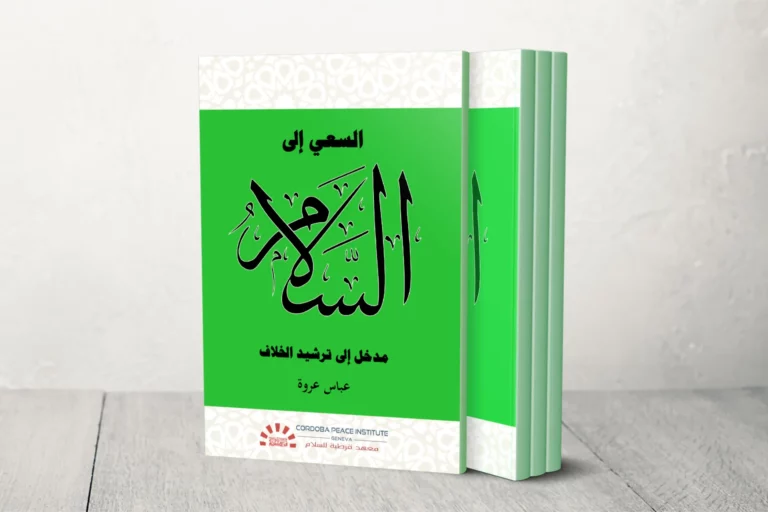
Nearly four weeks after the dialogue that brought together Moroccan Islamists and leftists in a forum organised by the Cordoba Foundation of Geneva, it continues to stir reactions in Moroccan circles, for it knocked on a door that had been all but closed between actors in Moroccan society – as in other Arab and Muslim societies – after decades in which estrangement had prevailed.
This rare dialogue was organised by the Cordoba Foundation of Geneva, a Swiss organisation whose members include Arab and European activists and which works on peace and on interreligious and intercultural dialogue. It brought together more than 40 experts and political actors from North Africa, West Asia and the Sahel, from both the secular and the Islamic currents, who discussed questions of trust-building and of establishing a framework for cooperation between actors with different intellectual premises and worldviews.
The initiative focuses on the importance of producing a new, shared political culture founded on the values of freedom, justice, dignity, diversity, acceptance of the other, non-exclusion, citizenship and the rejection of violence, by building alliances that cut across ideologies and contribute to the success of peaceful political transition in the Arab region.
Participants from Morocco included Nabila Mounib, secretary general of the Unified Socialist Party; Abdelali Hamieddine, member of the general secretariat of the Islamist Justice and Development Party; the researchers Ahmed Arehmouch and Hamed Idriss; the left-wing activist Khadija Ryadi, former president of the Moroccan Association for Human Rights; Mohamed Hamdaoui, member of the guidance council of the Islamic-oriented Al Adl Wal Ihsane movement; the Salafi sheikh Mohamed Abdelouahab Rafiki; and the left-wing researcher Maâti Monjib.
A positive atmosphere and natural differences
Referring to the outcomes of the dialogue, Mohamed Abdelouahab Rafiki, a researcher on Islamic affairs and a former Salafi detainee, said: “This meeting, divided into four dialogue workshops, was intended to ease the tensions the Arab region is experiencing. It was marked by the participation of a number of figures from various Islamic and secular currents, and even neutral participants and researchers interested in the subject. My own impression is that the dialogue took place in a very positive atmosphere and that there was agreement on most of the points raised, apart from some differences – natural differences between the two sides.”
Speaking to swissinfo.ch, Rafiki noted that “there was a rapprochement between these currents” and “a full awareness among all parties of the need to work on what they have in common, to tone down ideology and to keep intellectual differences out of the discussion”, adding that “what we share is far more important than these differences” and stressing that “the various parties are aware of this”.
The human rights activist Khadija Ryadi, who also took part in one of the workshops, told swissinfo: “This dialogue and this meeting between Islamists and leftists organised by the Cordoba centre came at the right time and was worthwhile; I was personally convinced by it. Because it brought together a group of leftist and Islamist figures from Morocco, it will add a great deal to the dialogue we have in Morocco between the two sides on this matter, since in Morocco we aspire to build a broad front of struggle between Islamists and leftists against despotism and corruption, as happened on 20 February” – a reference to the 20 February youth movement launched in Morocco in the context of the 2011 Arab Spring, which spurred political, constitutional and economic reforms.
Democracy and progress can only be achieved through understanding and rapprochement between the Islamist currents that say they believe in democracy and the leftist currents that say they work for democracy
Maâti Monjib, Moroccan historian and left-wing human rights activist
Dialogue instead of strife
In fact, the Geneva meeting held at the end of last August was only the fourth session of this forum, launched by the Cordoba Foundation with the support of the Swiss government to create dialogue rather than strife between the components of Arab and Muslim societies. The participants met in workshops over a full year: first in Istanbul (28 February – 4 March 2016), then in Doha (21–22 September 2016), then again in Istanbul (17 March 2017).
These meetings resulted in a final statement, issued in Geneva, which summarised the broad lines of the initiative under the title “Towards a space for communication and joint action”. It states that “acute polarisation in fragile contexts of political transition often leads to chaos, paving the way for the return of authoritarian regimes or for internal strife”.
The statement also explains that “emphasis was placed on the importance of producing a new, shared political culture founded on the values of freedom, justice, dignity, diversity, acceptance of the other, non-exclusion, citizenship and the rejection of violence, by building alliances that cut across ideologies and contribute to the success of peaceful political transition in the region”.
In this context, the participants agreed that “easing polarisation between Islamists and secularists should go beyond philosophical debate and focus on the need for joint action for the common good, to strengthen society and build the state”. This framework corresponds to a “common space” that requires no party to renounce its intellectual frame of reference or betray its cause. Indeed, this framework of joint action and collective effort in the service of society can be grounded in the religious and ideological frames of reference of all parties.
The statement noted that “groups with different rules within their value systems and worldviews can choose to engage in joint action with other, different groups, each for its own reasons”, and that “in this way, different groups can live together in a common space, each finding the justification and motivation to do so from the perspective of its own system of rules and guiding principles”. In this regard, the statement observed that the American philosopher John Rawls calls this process of joint engagement by different groups interacting within the same space an “overlapping consensus”.
Democracy, “the only solution”
The statement also stressed that living together is possible, especially since “the Charter of Medina is practical evidence, from an Islamic perspective, that coexistence and positive interaction are possible in a society of multiple tribal and religious affiliations”, and that this charter, which has been called the first constitutional document in human history, “succeeded in doing so by introducing a new concept of social belonging made up of three distinct layers: the tribe, recognised as a social reality; social belonging to a religion, which carries a system of shared values; and belonging to the city”.
The participants also recommended that “joint action focus on the major challenges facing the peoples of the region with regard to civic participation and the social engagement of young people, education, and the building of new political cultures”.
Speaking to swissinfo.ch, the Moroccan historian and left-wing human rights activist Maâti Monjib said: “There is no doubt that the dialogue was productive: at the end of it we reached an important conclusion, namely that the only solution to all the conflicts, contradictions and differing choices between these currents is democracy. Democracy and progress can only be achieved through understanding and rapprochement between the Islamist currents that say they believe in democracy and the leftist currents that say they work for democracy.”
Source:
مركز سويسري يُوفر فرصة نادرة للحوار بين إسلاميين ويساريين مغاربة (external website, opens in a new tab) · SWI swissinfo.ch
CPI is not responsible for the content of external websites.