Contribution by Abbas Aroua
Mr President,
Ladies and gentlemen, peace be upon you and the mercy of God.
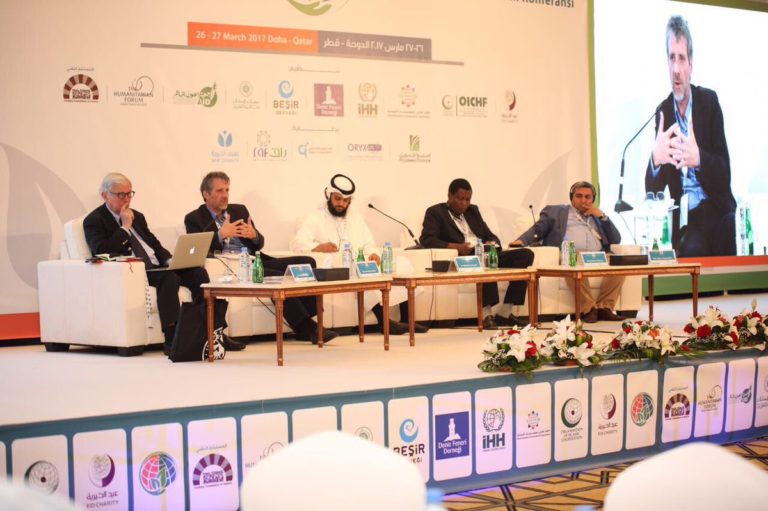
I would first like to thank warmly the organisers at Mabarrat al-Amal al-Khayri, headed by Dr Walid al-Tabtabai, for inviting me to address this distinguished gathering on the protection of charitable institutions under international law. I would like to begin with a brief presentation of the International Humanitarian Bureau, which brings together humanitarian and charitable associations.
The International Bureau emerged from the Paris Conference held in January 2003, attended by 150 charitable and humanitarian organisations. The proceedings of that conference were published in a book entitled Succouring the Vulnerable.
The International Bureau is an open grouping of all charitable and humanitarian associations wishing to communicate and coordinate with one another, share their experience, cooperate in solving the problems they face, and stand up to the attacks that target them or the abuses committed against them.
The second conference of charitable and humanitarian associations was then held in Geneva on 24–25 September 2004. Its objectives were:
1. To study the main problems facing non-governmental organisations in the third millennium, particularly in the context of globalisation;
2. To present an analysis of the forms of defence and mechanisms of protection for humanitarian NGOs at national, regional and international level;
3. To emphasise the role of charitable associations in the cohesion of the human fabric of society and in creating a climate of brotherhood, solidarity and cooperation among people, as well as the importance of their role in defending the social and economic rights of poor and destitute peoples or those who have been victims of wars, calamities and disasters, which requires that these associations be protected and their tasks facilitated;
4. To put in place means of guaranteeing the protection of charitable and humanitarian NGOs against all forms of arbitrariness and repression, particularly in wartime, and to circulate the draft universal declaration on the rights and responsibilities of people working in the humanitarian field, in the hope that it will be adopted by the United Nations General Assembly.
The International Bureau has two headquarters, one in Paris and the other in Geneva, and a regional office in the Gulf; the creation of further regional offices is under consideration.
The main activities of the International Bureau include:
1. Monitoring and documenting the situation of those working in the charitable and humanitarian field, associations and individuals, in various countries. The reports published or to be published shortly cover Egypt, Palestine, Saudi Arabia, Tunisia, Côte d’Ivoire and Brazil.
2. Organising training courses prepared with the participation of specialised international organisations, focusing on fieldwork on the one hand and on medical services on the other. To make the best use of its resources, the Bureau tends to organise training courses on the margins of conferences and seminars.
3. Making the International Bureau known abroad. Last summer, for example, a lecture and debate chaired by the Bureau’s president, Dr Haytham Manna, were held in Geneva on the occasion of the cultural event “Tent of Dialogue” organised by the Cordoba Foundation of Geneva, and the Bureau met with a strong response from the participants. Visits by Bureau delegations to Britain, Germany, the United States and Morocco are planned.
4. Developing and upgrading the Bureau’s website, which plays an important role in communication among members and in making the Bureau’s activities known.
5. Issuing statements whenever necessary, particularly when a member of the Bureau, individual or association, is subjected to harassment and arbitrary measures.
6. Working for the adoption by the United Nations General Assembly of the universal declaration on the rights and responsibilities of people working in the humanitarian field, by making it known in international forums and rallying support for it.
I now turn to the subject of my contribution: the protection of charitable institutions under international law. It is worth stressing at the outset the importance of international protection, for two reasons. The first is the globalisation of arbitrariness and persecution on the pretext of the so-called “war on terror”, which now takes every form: obstructing movement by refusing visas to many people working in the charitable and humanitarian field; a carefully designed policy aimed at drying up the financial resources without which no charitable work is possible, criminalising a number of workers and driving many more away from this vital field. The arbitrariness has gone so far as to deny the right to a defence to some of those whose names were placed on lists drawn up by the intelligence services of the American administration and circulated to law firms in some Western countries so that they would refuse to take them on. The second reason why international protection is so important is the suspension of domestic laws, the failure of judicial systems and the absence of the international community that we suffer in many countries, particularly in the Arab and Muslim world.
Before turning to the European and UN mechanisms, I would like to point to another arena to which we should turn in defending charitable and humanitarian organisations: European and Western public opinion in general, represented and expressed by civil society, individuals, associations and a free press. This public opinion has great influence on decision-making centres, not only in the West but even in the Arab and Muslim world. A single fax from a Western organisation landing on an official’s desk in an Arab or Muslim country often carries more weight than the voices of thousands of that country’s citizens.
But what is the position of European public opinion on Arab and Muslim affairs?
In reality there is no single position, but a spectrum of positions. Let me illustrate this with something that happened to me on the plane yesterday, on my way from Geneva to Kuwait. I picked up a newspaper and was surprised to find a harshly worded article attacking the Muslim community living in Switzerland. What caught my attention was the photograph accompanying the article: an imam of a mosque in a Swiss city, captured in a diabolical way, with his mouth open, his facial muscles clenched and his hands waving, as if he were threatening the reader and about to leap out of the page to attack him. This intimidating technique has been common for years in photographing Islamic figures and publishing the pictures in the major Western newspapers, in order to fix in the Western collective consciousness the image of the savage Arab Muslim who threatens the civilised world and must be guarded against.
On the same flight, while I was leafing through the newspaper, an elderly Swiss man sat down next to me. We soon struck up a conversation, and I learned that he was on his way to India; that he had retired ten years earlier; and that he had since decided to spend four months a year in southern India helping the people of poor, remote areas. He told me that in his work he made no distinction between Buddhist, Hindu and Muslim: he had, for example, contributed from his own money to building primary schools in Muslim villages, even though he himself still doubted the existence of the Creator.
Within a few minutes I had come across two Western types: one hostile to Muslims, and one who gives his time and money to help the deprived among them. Between these two ends of the spectrum lies a broad middle of citizens who are usually the victims of disinformation campaigns against Arabs and Muslims. The same picture applies to associations, which can be divided into three categories, as Dr Haytham Manna shows in his article “Links with international organisations”.
As for international mechanisms, at European level it is possible to make use of the European Convention on Human Rights and to apply to the European Court of Human Rights once domestic remedies have been exhausted in the states that have ratified the Convention. This shows the importance for charitable and humanitarian organisations and associations of being represented in Europe, and specifically in Geneva, where such organisations can obtain accreditation with the United Nations Economic and Social Council in order to make better use of UN mechanisms and to communicate with the major international organisations and the many non-governmental organisations based in Geneva.
At UN level, I have noticed in conversations with some colleagues their reservations about the efficacy and effectiveness of the United Nations. I fully understand these reservations, since the organisation has often given in the past, and still gives today, the image of an organisation of powerful governments rather than a gathering of nations and peoples. But I believe it is our duty to make use of its mechanisms, if only to hold it to account.
There are three ways of engaging with UN mechanisms:
1) Using the UN human rights mechanisms, since arbitrary measures against those working in the charitable and humanitarian field translate on the ground into violations of human rights such as the right to form associations, the right to property, the right to freedom of movement, the right to liberty and the right to a fair trial, etc. Many UN mechanisms can thus be used: ratified conventions and protocols, specialised committees and working groups, special rapporteurs and representatives of the Secretary-General.
2) Working to obtain a UN declaration affirming that charitable and humanitarian work is a human right, like the right to defend human rights, recognised for some years now.
3) Working for the adoption by the United Nations General Assembly of the universal declaration on the rights and responsibilities of people working in the humanitarian field, and calling for the appointment of a representative of the Secretary-General responsible for those working in the charitable and humanitarian field.
I would like to stress the second and third points, because there is a historical precedent for such action: the Declaration on the Right and Responsibility of Individuals, Groups and Organs of Society to Promote and Protect Universally Recognized Human Rights and Fundamental Freedoms, and the appointment of a Special Representative of the Secretary-General. It may be useful to recall the circumstances in which this declaration was adopted and the Special Representative appointed.
The draft declaration on human rights defenders was drawn up by associations and individuals in 1984. The following year, by its resolution 1985/112 of 14 March 1985, the Commission on Human Rights set up an open-ended working group to draft an instrument on human rights defenders. The declaration was adopted by the United Nations General Assembly in its resolution 53/144 of 9 December 1998, on the fiftieth anniversary of the adoption of the Universal Declaration of Human Rights, after fourteen years of negotiations between member states and non-governmental organisations.
It should be noted that Article 1 of the Declaration states that “Everyone has the right, individually and in association with others, to promote and to strive for the protection and realization of human rights and fundamental freedoms at the national and international levels.”
A year and a half after the adoption of the Declaration, the Commission on Human Rights, by its resolution 2000/61 of 26 April 2000, requested the Secretary-General to appoint a Special Representative for a period of three years to report on the situation of human rights defenders throughout the world and on possible means of enhancing their protection in full compliance with the Declaration. The Economic and Social Council (ECOSOC) endorsed this request in its decision 2000/220 of 16 June 2000.
On 18 December 2000, the UN Secretary-General appointed Ms Hina Jilani, of Pakistan, as his Special Representative on human rights defenders. According to the resolution of the UN Commission on Human Rights, the main activities of the Special Representative are:
(a) To seek, receive, examine and respond to information on the situation and the rights of anyone, acting individually or in association with others, to promote and protect human rights and fundamental freedoms;
(b) To establish cooperation and conduct dialogue with governments and other interested actors on the promotion and effective implementation of the Declaration;
(c) To recommend effective strategies better to protect human rights defenders and to follow up on these recommendations.
The Special Representative was also asked to submit annual reports on her activities to the Commission on Human Rights and to the General Assembly, and to make any proposals and recommendations enabling her better to carry out her tasks and activities. The UN Commission on Human Rights urged all governments to cooperate with the Special Representative, to assist her in performing her tasks and to provide, upon request, all the information needed to fulfil her mandate. So far, the Special Representative has produced four annual reports (2001, 2002, 2003 and 2004) assessing the situation of human rights defenders and making recommendations to improve it.
Clearly, those working in the field of human rights and those working in charitable and humanitarian work face common problems. In her second report, A/57/182 (2002), for example, the Special Representative of the UN Secretary-General on human rights defenders refers to the harassment suffered by human rights organisations, and in particular to the problem of funding, from which charitable organisations suffer even more severely. In the chapter on conclusions and recommendations (paragraphs 94 and 95), she writes:
“94. In consultations held in all regions, defenders expressed concern that national laws regulating the activities of parties and trade unions in many countries impose a wide range of restrictive conditions on the management, operation and funding of non-governmental organisations. In West Asia in particular, violations of these laws, which amount to no more than the exercise of the right to freedom of association, have led to the prosecution of human rights organisations, the closure of their offices and their activities being declared unlawful. […]
95. The question of foreign funding has become a sensitive point of tension between governments and human rights defenders. Governments have shown excessive sensitivity towards international funding of non-governmental organisations. While the need for transparency in this regard is understandable, the roots of the issue lie in the ethics and credibility of these non-governmental organisations; transparency cannot be imposed through laws that violate their independence or allow their members to be prosecuted. […]”
In her fourth report, dated 15 January 2004, the Special Representative of the UN Secretary-General on human rights defenders encourages national and international non-governmental organisations “to develop and strengthen coalitions and networks to increase the protection of human rights defenders.”
The most important means of protection therefore remains to unite our efforts, coordinate our work and jointly confront obstacles and harassment.
Although those working in the charitable and humanitarian field do not yet have a UN declaration setting out their rights and responsibilities, nor a Special Representative of the Secretary-General, for nearly two years they have had an International Bureau that serves as a laboratory of coexistence, a space for sharing experience, for consultation and cooperation, and a voice making known the difficult situations that charitable and humanitarian associations face worldwide. We are called upon to support this Bureau so that it can carry out its tasks as well as possible.
Thank you for your attention. Peace be upon you.