Means and mechanisms of protection
1. Introduction
Over the course of the 20th century, humanitarian and charitable NGOs went through a peaceful revolution that turned what had been a marginal phenomenon until the end of the 19th century into a true societal expression of solidarity between human beings. To this was added the development of their roles, their internal structures and their relations with political and civil society, both nationally and internationally. While the stock exchange is responsible for the deaths of tens of thousands of human beings every year, without a single businessman ever crossing the borders of poor countries, humanitarian action tries to save just as many people on the ground in the countries concerned. Humanitarian NGOs have thus become a reality within the geopolitical framework of states and in people’s aspiration to a better life.
Governments and political groups, having understood the importance of the NGO phenomenon, which has become a major legal and civic issue at home and abroad, have sought to influence NGOs, to contain them and to use them for political and cultural ends.

The instrumentalisation and manipulation of humanitarian NGOs have greatly weakened the phenomenon and sown doubt in international public opinion, which loses its unity and universal spirit whenever the humanitarian action of the other is mentioned. The deaths of the American doctors who had devoted their lives to the sick in Yemen provoked very little protest in the Arab world. The same is true of Rachel, the young American woman killed under an Israeli bulldozer in Gaza, but this time in her own country, the United States. Politics and ideologies are making us lose an essential principle of the humanisation of our existence: the need to discover the capacity of international solidarity to build bridges between peoples and cultures.
11 September may be a date like any other for the NGOs of the North, but for those of the South, and especially Islamic ones, it was a catastrophe in every respect. The passing troubles experienced by associations of an Islamic character turned into a genuine war, never acknowledged by the American administration: a war that used emergency laws and secret-evidence procedures to cover up abuses targeting a large number of associations known for their great professionalism and good results.
A merciless war was waged against them, including the freezing of their assets, their arbitrary branding as terrorists, and their constant surveillance in a way that frightens the public and drives volunteers away. Volunteers from one charity were even tortured by Italian forces serving with IFOR (in Kosovo), in flagrant violation of the European Convention for the Protection of Human Rights and Fundamental Freedoms.
All this is happening in a way that distances citizens from these natural expressions of some one billion Muslims, who have the right to choose the working methods of their humanitarian associations, their programmes and the means of developing them.
This campaign confronts us with the problem of coordination between the humanitarian NGOs of the North and those of the South, in order to preserve the natural bridge that unites all charitable and humanitarian associations around most of their objectives and activities.
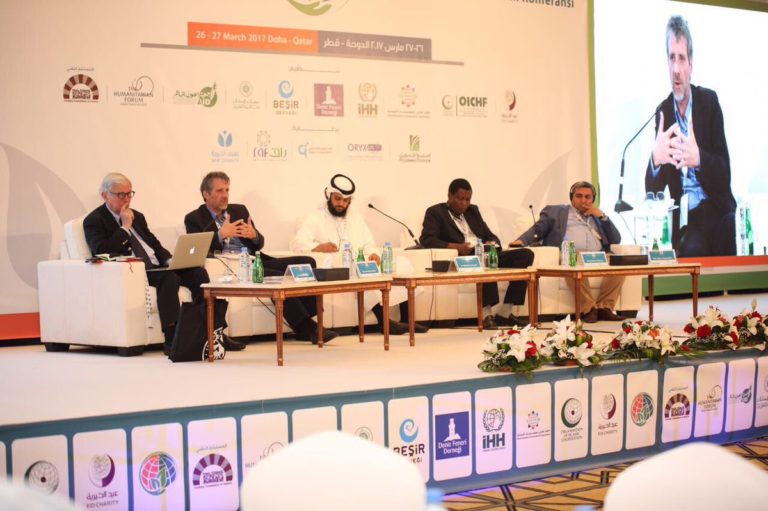
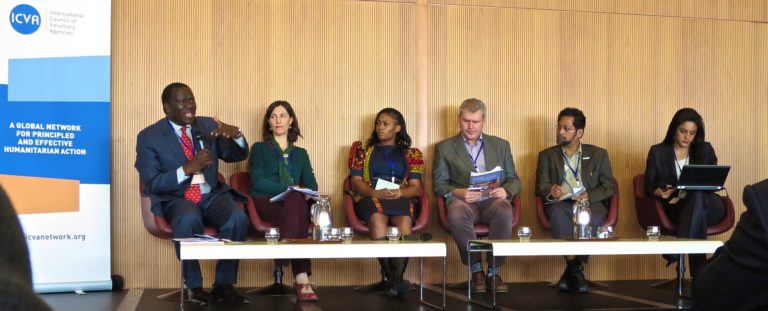
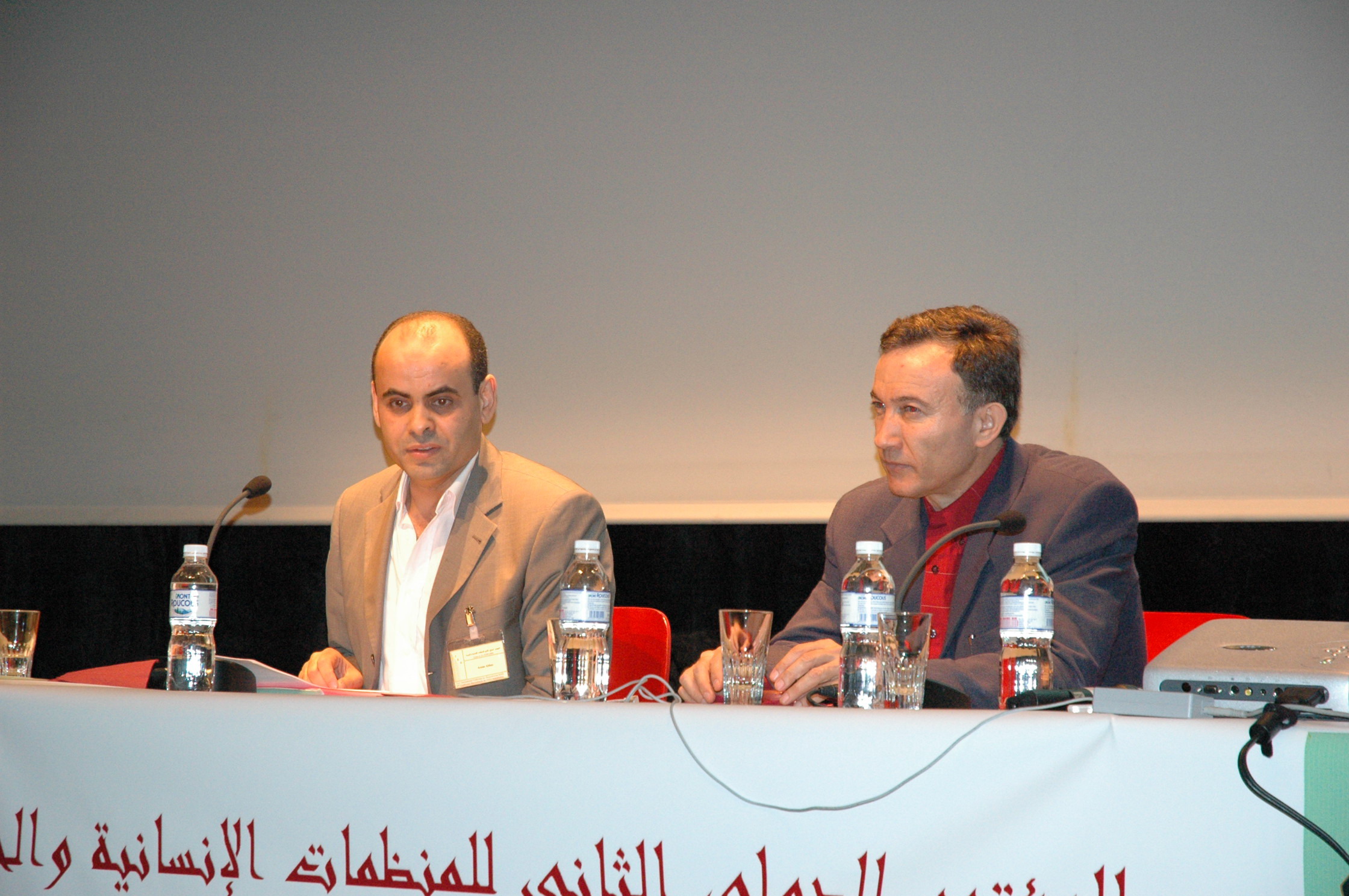
To prevent politicians from undermining this essential pillar of the life of peoples, the Arab Commission for Human Rights (ACHR) called for the Paris Conference of Humanitarian NGOs. It brought together 151 humanitarian and charitable NGOs whose principles of action comply with international humanitarian law, and which regard the protection of individuals from disasters as central to their objectives. Specialist experts and a good number of intergovernmental organisations, such as the EC, the OHCHR, UNESCO, the International Red Cross, UNICEF and the WHO, took part in the conference. An International Bureau was elected to form an international confederation of humanitarian NGOs capable of coordinating their action and protecting the people and associations engaged in humanitarian work. This bureau is now calling for the 2nd International Conference of Humanitarian NGOs.
2. General format of the conference
The conference will take place in Geneva from 24 to 26 September 2004. It will bring together no fewer than 180 representatives of humanitarian and charitable NGOs, half of them from countries of the South, and will use three languages: French, Arabic and English.
3. Objectives of the conference
To study the main problems facing charitable and humanitarian NGOs at the beginning of the third millennium, particularly in the context of globalisation.
To present a synthesis of the means of defence and the mechanisms of protection of humanitarian NGOs, at both national and international level.
To highlight the role of charitable associations in weaving the human fabric of society and in fostering a climate of fraternity, solidarity and mutual aid among fellow citizens, as well as their important role in defending social and economic rights among poor and destitute populations or those experiencing wars, tragedies or disasters, which calls for their protection and for their work on the ground to be facilitated.
To act on the need to put in place a mechanism guaranteeing the protection of charitable and humanitarian NGOs against all forms of arbitrariness and repression, particularly in times of armed conflict, and to disseminate widely the universal declaration produced by the Paris Conference on the rights and responsibilities of individuals and groups working in the humanitarian field, with a view to its adoption by the United Nations General Assembly, as was the case for the protection of human rights defenders.
4. Actions to be undertaken
A preparatory committee made up of Swiss and international figures is in charge of organising the conference.
Obtaining the agreement of the NGOs wishing to take part in the conference, by sending them letters setting out its objectives and outlining its general framework and proposed programme, to be followed by invitations to the participants.
Sending proposals to specialists who will present papers on charitable and humanitarian work.
Careful assessment of the media dimension of the conference, to ensure that information is well disseminated before, during and after the proceedings.
5. Themes of the conference
Assessment of the work of associations worldwide and of their capacity to respond to human needs in times of peace and war, together with an examination of the situation of NGOs prosecuted for their activities, through NGOs that have been neutralised by the globalisation of the state of emergency.
Assessment of the means of defence and the mechanisms of protection of humanitarian NGOs, and proposals for improving these mechanisms.