On 14 October 2026, CPI and the Center for Security Studies (CSS) at ETH Zurich held a panel at the Geneva Peace Forum 2026 (external website, opens in a new tab) on a question that peace mediators face more and more often: can Islamic jurisprudence (fiqh) serve as a framework for negotiations with armed movements that claim to follow it – and at what cost?
About the session
The session combined a policy briefing on the role of Islamic jurists in armed conflict with a critical discussion of engaging Islamist armed actors in mediation. It drew on several years of research in Iraq, Yemen, Mali, Mozambique and Somalia, which shows that Islamic jurists help shape how armed groups govern and set rules for the conduct of hostilities, and that they can sometimes open – or close – the way to dialogue.
The speakers discussed the political, ethical and operational dilemmas of recognising Islamic jurisprudence as a normative framework in mediation: the risk of legitimising armed actors, the instrumentalisation of religious arguments and unintended consequences, as well as the conditions under which such engagement can strengthen mediation.
- Date: Wednesday 14 October 2026, 11:00–12:30 (CEST)
- Venue: International Conference Centre Geneva (CICG), Plenary EF, and online
- Organisers: CPI, with the Center for Security Studies (CSS), ETH Zurich
- Programme: Geneva Peace Forum 2026 (external website, opens in a new tab), “Mediation in Focus”
Speakers
- Nicolas Masson, Head of the Mediation and Dialogue Section, Swiss Federal Department of Foreign Affairs (FDFA)
- Lakhdar Ghettas, Programme Manager, CPI
- Ambassador Jan Wahlberg, Senior Adviser for Mediation, Ministry for Foreign Affairs of Finland
- Lisa Reefke, Special Assistant, Office of the Special Representative of the Secretary-General, United Nations Assistance Mission in Afghanistan (UNAMA)
- Judith Huppertz (online from Kabul), Special Assistant to the Deputy Special Representative of the Secretary-General (Political), UNAMA
- Moderator: Emanuel Schäublin, Deputy Head of the Mediation Support Team, CSS, ETH Zurich
Watch the session
Fiqhi Pathways
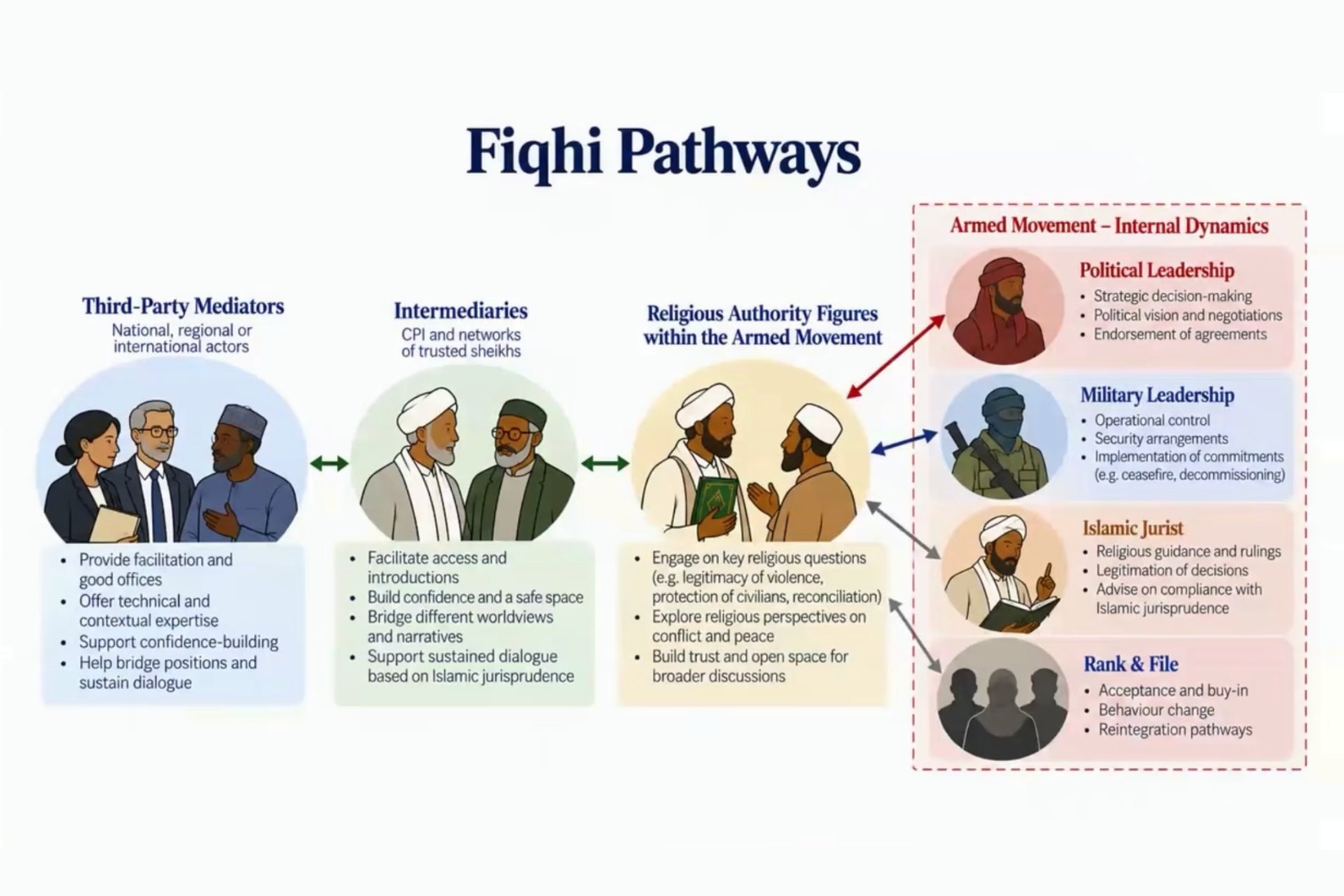
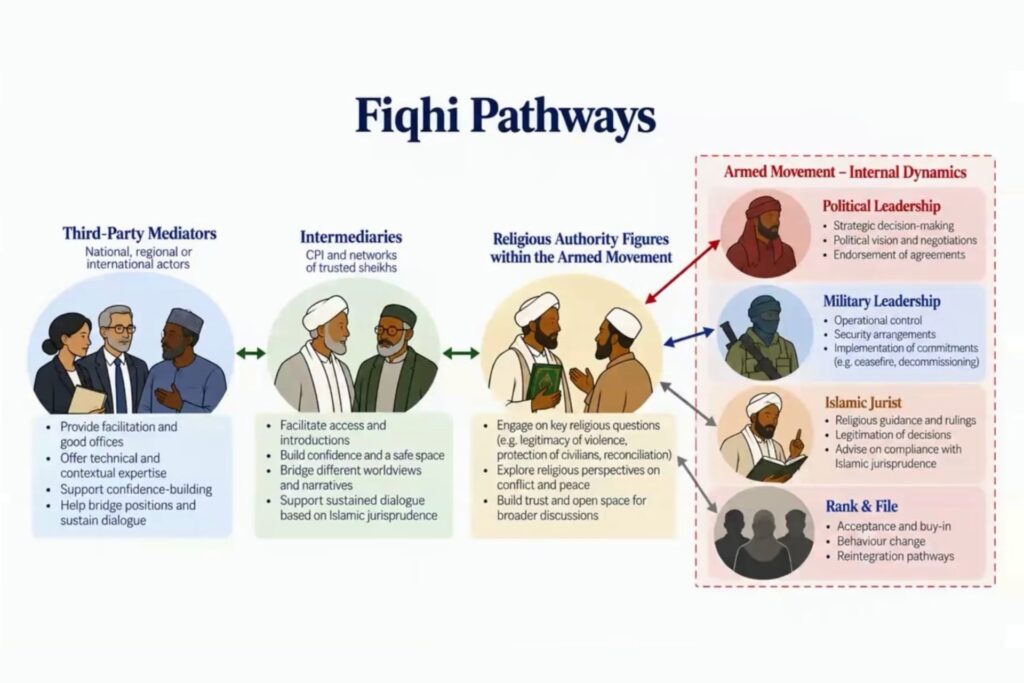
The diagram at the top of this page (view it in full size) sets out the approach of CPI’s Fiqhi Pathways project, implemented with the Peace and Human Rights Division of the Swiss FDFA. Third-party mediators – national, regional or international actors – work through intermediaries: CPI and networks of trusted sheikhs, who facilitate access and introductions, build confidence and a safe space, and support sustained dialogue based on Islamic jurisprudence.
These intermediaries engage religious authority figures within the armed movement on key religious questions, such as the legitimacy of violence, the protection of civilians and reconciliation. Those figures in turn interact with the movement’s political leadership, its military leadership, its Islamic jurists and its rank and file, whose acceptance any agreement ultimately needs.
Background
The panel built on the research project that CPI and CSS concluded in June 2025 with a policy briefing in Brussels, which examined how Islamic legal scholars shape the actions of armed groups and open space for negotiation.
Featured image: Fiqhi Pathways © CPI Geneva. Session details: Geneva Peace Forum 2026 programme (external website, opens in a new tab), Geneva Peacebuilding Platform.
CPI is not responsible for the content of external websites.