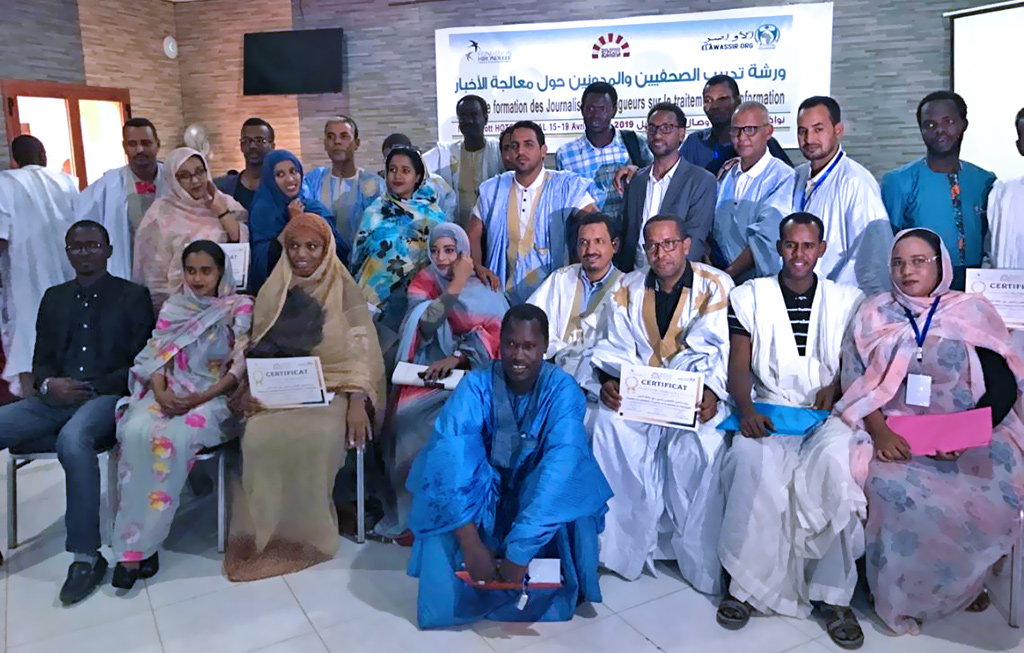
Michel Beuret, Editorial Manager of the Hirondelle Foundation, led a training course in Nouakchott from 15 to 19 April on the ethical and professional foundations of journalism, to identify and defuse the false information circulating on social media.
Participants: 30 journalists from the country’s different communities and from broadcast, print and online media.
Nouakchott, 15–19 April 2019
Michel Beuret, Editorial Manager of the Hirondelle Foundation, led a training course in Nouakchott from 15 to 19 April on the ethical and professional foundations of journalism, to identify and defuse the false information circulating on social media.
Participants: 30 journalists from the country’s different communities and from broadcast, print and online media.
The first round of the presidential election in Mauritania will take place on 22 June, amid social, political and economic tensions mixed with ethnic and religious undercurrents. According to Reporters Without Borders, press freedom in Mauritania has regressed sharply since 2014, after the country had made progress in this area in previous years. Its media landscape is underdeveloped, poorly qualified and largely made up of bloggers with no professional bearings.
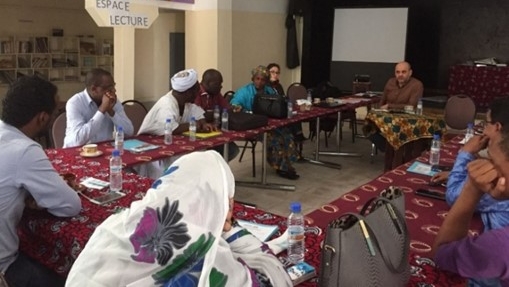
As part of a partnership with the Cordoba Foundation of Geneva (whose aim is “to foster exchange between the cultures and civilisations of different communities”), the Hirondelle Foundation ran a media training course for 30 Mauritanian journalists and bloggers. The workshop, held in Nouakchott in mid-April, was led by Michel Beuret, Editorial Manager of the Hirondelle Foundation, and funded by the Kingdom of the Netherlands.
The training had to be inclusive: the 30 participants came from all media (public and private, radio, TV, print, internet), women and men reflecting the country’s cultural diversity: White Moors, Black Moors and Black Mauritanians (Soninke, Fulani, Wolof, etc.).
The 30 participants had been selected individually during an earlier mission, in January 2019, that made it possible to conduct some sixty interviews.
The Nouakchott training focused on working with sources, the journalist’s editorial responsibility and professional ethics, as well as several practical exercises on false information in the age of social media, the risk of passing it on and the professional way to avoid or defuse it.
Since some participants spoke only Arabic and others only French (or a local language), the training required permanent simultaneous interpretation.
In the participants’ view, this interpretation also had the advantage of helping them get to know one another and become involved. Habib Sal, representing Mauritanian public radio: “We really learned a lot from this training (…). Before, we often had workshops where people took part on the first day, and then the room was empty until the last day, when people came back to collect their certificates. But this time people stayed for all five days. That shows how important this workshop was and how interested the participants were. It was extraordinary (…). Coming out of this workshop, I think we are better equipped and have more arguments to practise the profession of journalism.”
Testimony from one of the journalists who took part, to watch here:
Source: Le journalisme pour desamorcer les rumeurs notre formation en mauritanie (external website, opens in a new tab) · hirondelle.org
CPI is not responsible for the content of external websites.