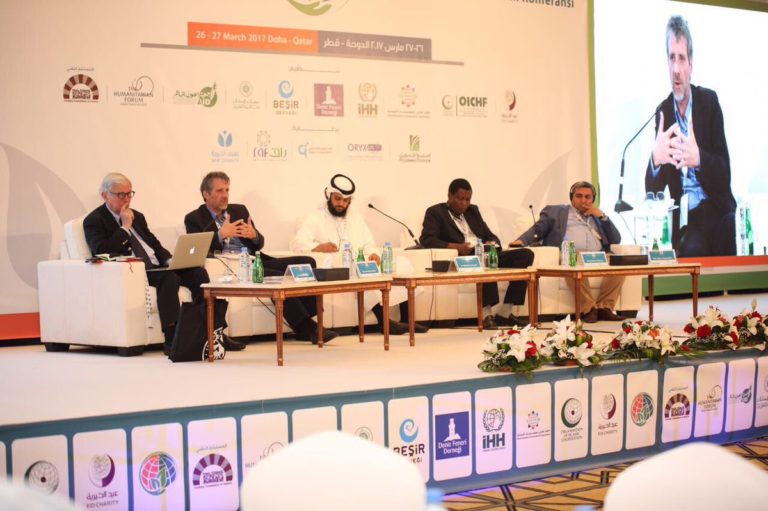
The 2nd Conference of Humanitarian and Charitable NGOs took place at a time of growing humanitarian and charitable needs. Conflicts, wars, occupations and natural disasters have reduced new populations to destitution and poverty. The situation of refugees has deteriorated across the world, particularly in Palestine, Africa and Asia. In Darfur and Southern Sudan, thousands suffer from forced displacement, hunger and disease. In Palestine, Sharon’s continuing policy of aggression has driven thousands of Palestinians from their homes, notably because of the separation wall that continues to be built despite its condemnation by the International Court of Justice. On top of this, demolitions and killings of Palestinians have multiplied.
At the same time, the occupation of Iraq and the collapse of the Iraqi state have paralysed infrastructure and public services that were already badly degraded. Aid and relief for Iraqis and the distribution of medicines have thus become difficult tasks, taken on by the humanitarian and charitable NGOs formed after the fall of the former regime. To some extent, these NGOs have been able to relieve the population of a number of hardships.
Humanitarian and charitable NGOs have also had to face many natural disasters, against which they have mobilised considerable resources.
Besides these considerable efforts, humanitarian and charitable NGOs have had to contend with obstruction by states and the arbitrary use of power on various pretexts. Some of these obstacles have prevented NGOs from being present in disaster or conflict zones, adding a further burden on these organisations.
In order to support these NGOs, facilitate their work and defend them, the participants:
1) call for the implementation of the instruments of international law, international covenants and conventions, and United Nations resolutions on the protection of humanitarian and charitable NGOs. This requires a sustained effort to inform these NGOs of the rights and forms of protection provided for by these texts, which they can use to protect themselves, and to assist them in this area;
2) call for work to propose new texts that would enrich and strengthen the legal tools currently available for the protection of humanitarian and charitable NGOs and their staff;
3) call on the IHB to broaden its scope to support humanitarian and charitable NGOs in their fields of activity, by facilitating their communication and guiding them in mastering the acquisition of resources;
4) call on the international community and United Nations institutions to reject the labelling of any NGO or individual with designations that would hinder the exercise of their mission on the basis of political decisions or accusations, whatever their origin, and to abide only by well-founded court decisions;
5) call on the United Nations to set up a commission of inquiry tasked with examining the merits of any accusation against any NGO or individual, whether or not a member of the UN;
6) call for stronger cooperation and partnership among humanitarian and charitable NGOs, and between them and irreproachable sources of funding, whatever their affiliation and orientation, in the service of humankind regardless of race, colour, sex or religion;
7) call on NGOs to practise full transparency, respect international and local laws, and observe their statutes and terms of reference;
8) call on the international community to apply the Geneva Conventions and the international conventions on the protection of humanitarian and charitable NGOs, their staff and their resources against the obstruction, aggression and terrorist acts to which they are subjected;
9) call for national laws to protect people working in humanitarian action and human rights, and to facilitate the work of NGOs;
10) call for the condemnation of all acts of violence, whoever their perpetrators, against civilians, humanitarian and charitable NGOs and their staff, and for the denunciation of all forms of terrorism, including state terrorism;
11) call for an end to all forms of occupation, for the preservation of the sovereignty of peoples, and for a distinction to be made between legitimate resistance to occupation and terrorism;
12) call for work towards the peaceful resolution of internal conflicts and for radical reforms that safeguard the interests of peoples and respect the provisions of international law, in order to prevent disasters;
13) call for the freedom of humanitarian and charitable NGOs to deliver aid to the parties to a conflict to be guaranteed, as is the case for the ICRC;
14) call for broader representation of humanitarian and charitable NGOs within the IHB;
15) call for the IHB’s work to be stepped up;
16) call on the IHB to work for the adoption of a universal declaration on the rights and responsibilities of individuals and groups engaged in humanitarian and charitable action.
Geneva, 25 September 2004